
Two Bonds, One Ballot: What Raleigh’s Housing and Transportation Bonds Would Fund, and Why They Don’t Require a Tax Increase
In RaleighForward’s August 30 newsletter, we took a closer look at Raleigh’s new Strategic Plan and the priorities that will guide the City over the next several years. Among those priorities are two issues that impact Raleigh residents every day: housing and transportation. This November, voters will have a direct say in how Raleigh invests in both.
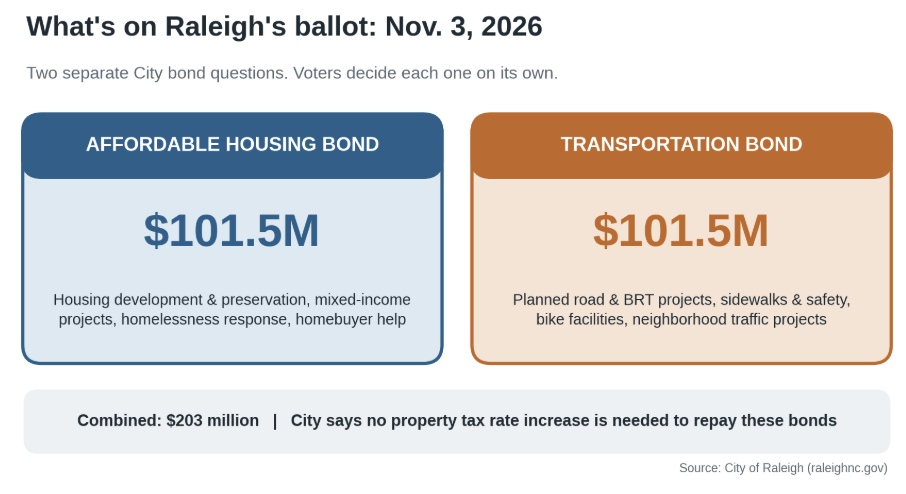
When Raleigh voters fill out their ballots this fall, they will find two City bond questions: a $101.5 million Affordable Housing Bond and a $101.5 million Transportation Bond. After a May 19 public hearing, City Council approved both bond orders for the November 3 election. Each question is decided separately.
Together, the bonds authorize $203 million in borrowing, and according to the City, that debt can be repaid without raising the property tax rate. Understanding why requires a look at the ballot itself, the projects, and a financing approach the City calls “steady state.”
Reading the Ballot
North Carolina law prescribes the wording of every general obligation bond question. Each will state that additional property taxes may be levied to repay the bonds, then list two estimates: the cumulative cost of the bonds, calculated using the highest interest rate charged on similar debt over a look-back period equal to the maximum bond term, and the tax liability per $100,000 of property value. Here is how the City Bond language appears on the Ballot:
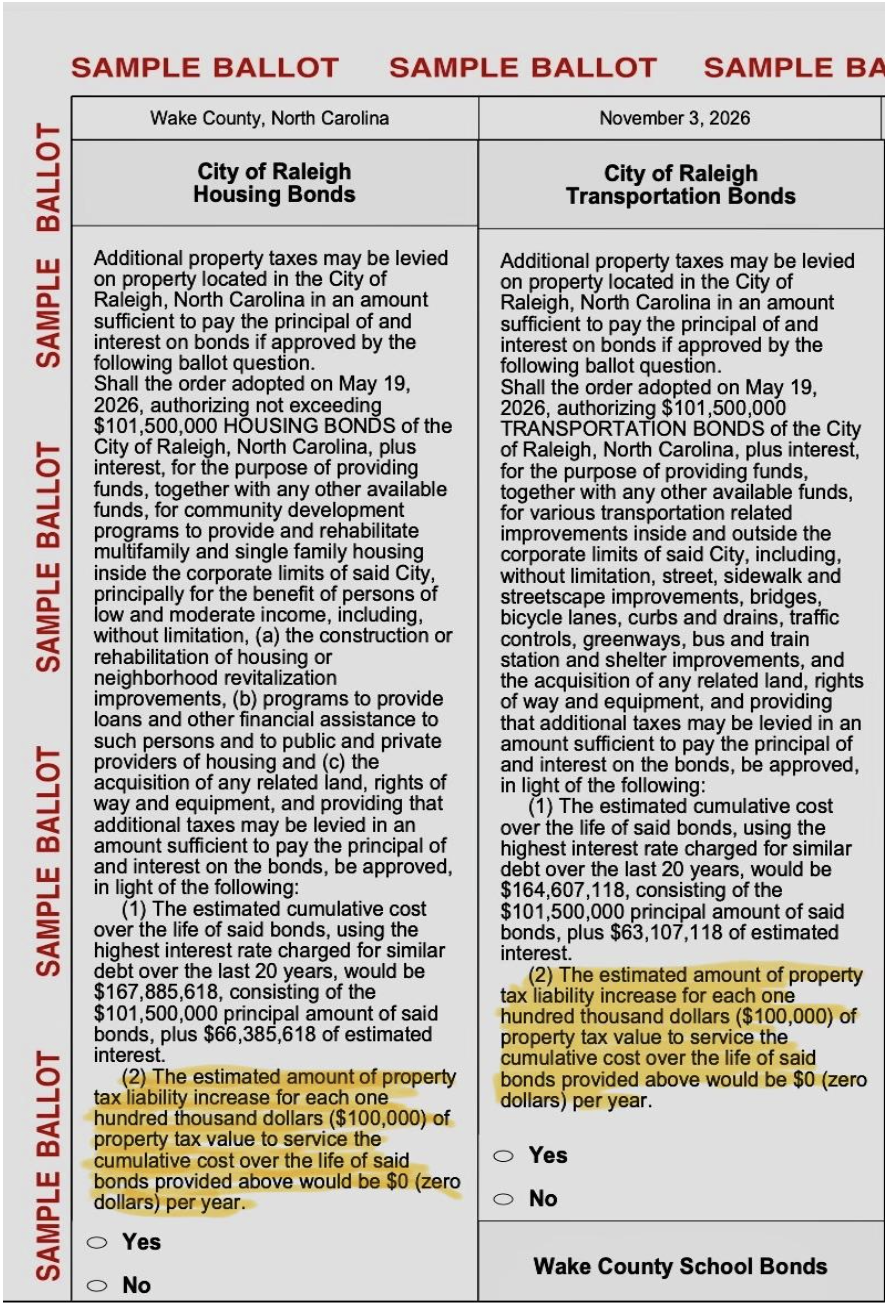
That language is required on every general obligation bond because the City’s taxing authority guarantees the debt, whether or not a rate increase is planned. Raleigh voters will also see separate Wake County questions for public schools and Wake Tech, which carry their own estimated county tax impact.
The Affordable Housing Bond
As Raleigh grows, housing affordability has become one of the most pressing challenges facing the City.
The proposed Housing Bond will help create and preserve affordable housing, help residents become homeowners or remain in their homes as they age, support mixed-income development, and strengthen Raleigh’s response to homelessness.
The bond provides about $25.4 million annually from FY2027 through FY2030, 58 percent more per year than the 2020 bond. That $80 million bond, approved by 72 percent of voters, helped build or preserve nearly 2,500 affordable homes.
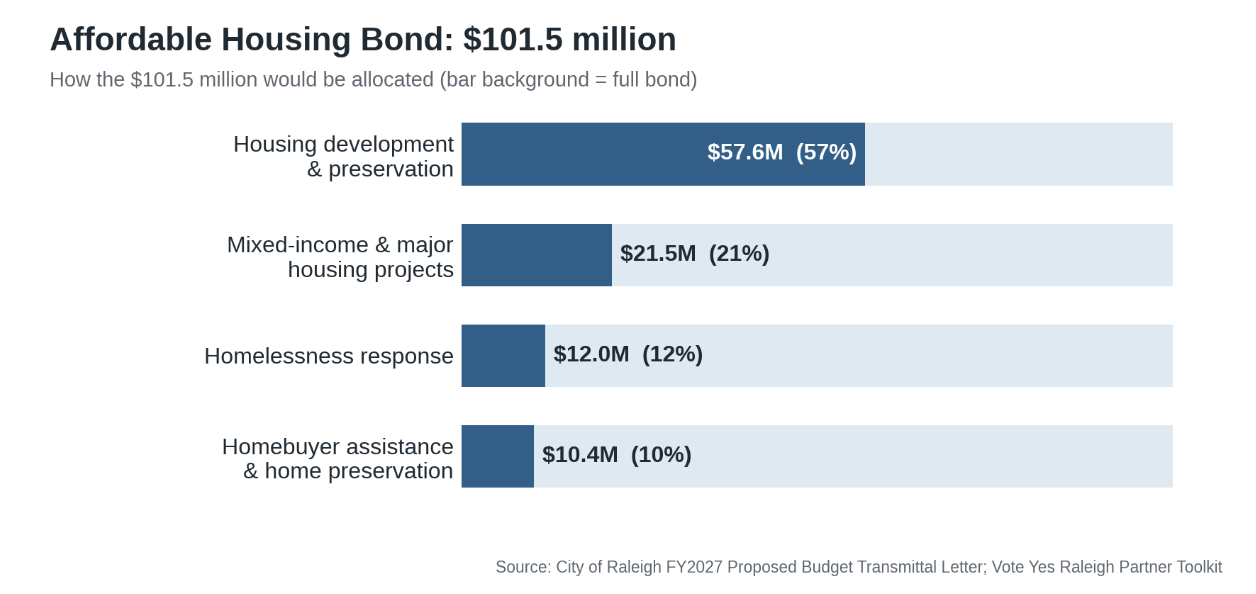
Housing development and preservation ($57.6 million). Gap financing for new income-restricted housing, preservation and rehabilitation of naturally occurring affordable housing.
Mixed-income and major projects ($21.5 million). Seeds a loan fund for mixed-income developments. Housing Director Emila Sutton told Council roughly one-third of units in these projects would be affordable, and repaid loans would be relent to future projects.
Homelessness response ($12 million). Supports the Wake@Home unsheltered homeless response initiative, building on a 2024 rent-assistance pilot that helped move 45 people from an encampment into stable housing.
Homebuyer assistance and home preservation ($10.4 million). Down payment assistance for eligible first-time buyers, repairs that keep existing owners in their homes and help for seniors who want to age in place.
For a growing city, housing is an economic issue. When teachers, first responders, healthcare workers, service employees and young families can afford to live closer to where they work, Raleigh benefits from stronger neighborhoods, a more accessible workforce and shorter commutes.
The Transportation Bond
Growth also puts increasing pressure on Raleigh’s transportation infrastructure. The proposed Transportation Bond funds improvements to roads, sidewalks, intersections, bridges, bicycle infrastructure and other connections residents rely on every day.
The goal is not simply to build more infrastructure, but to make it easier and safer for people to move around Raleigh whether driving, walking, biking or using transit.
That also reflects the direction established in Raleigh’s Strategic Plan, which calls for closing gaps in the sidewalk and bicycle networks, improving safety for pedestrians and cyclists, and making transportation investments that support the city’s continued growth.
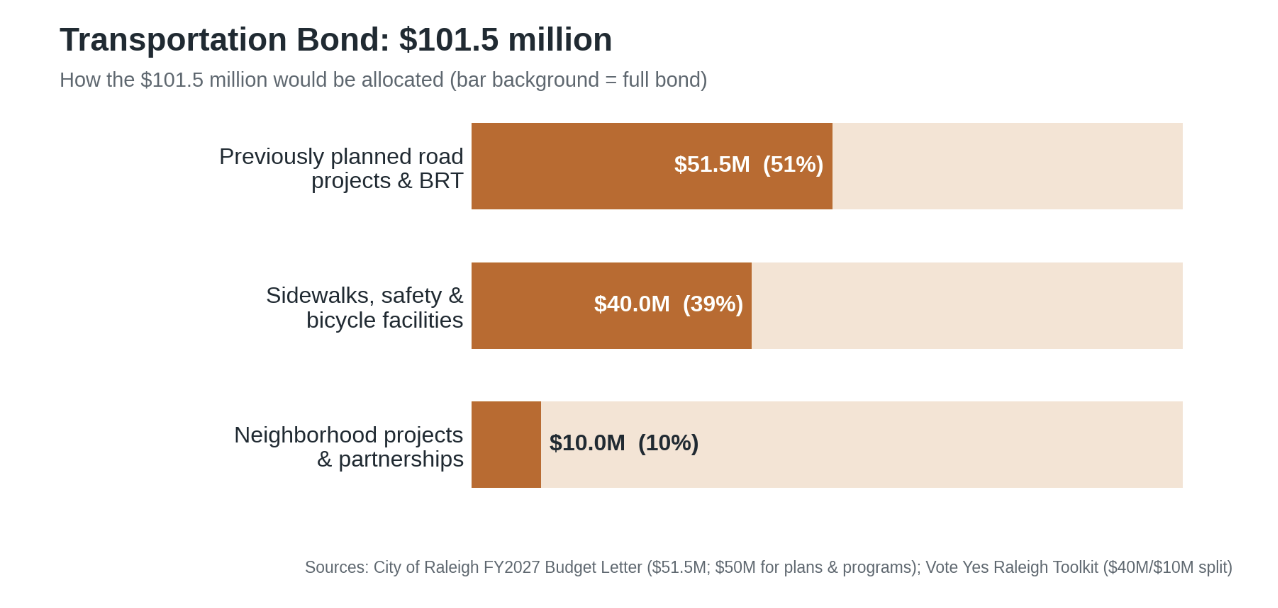
Previously planned projects and Bus Rapid Transit ($51.5 million). Designed projects that are closer to construction, including three deferred from the 2017 bond (Marsh Creek Road, Trawick Road-West and Ebenezer Church Road), plus general-purpose lanes associated with BRT.
Sidewalks, safety and bicycle facilities ($40 million). Advances the Active Mobility Plan’s “Big Jump,” a goal of five miles of sidewalks and 50 miles of high-comfort bikeways in five years, along with safety improvements.
Neighborhood projects and partnerships ($10 million). Funds traffic calming and intersection safety, on neighborhood streets as well as partnerships that support existing planned projects.
For the transportation bond, safety is the throughline. In April, Council adopted a Comprehensive Safety Action Plan aiming to cut fatal and serious-injury crashes in half by 2040. City data show crashes involving pedestrians, cyclists or scooter riders are more than four times as likely to cause death or serious injury.
How “Steady State” Works
Historically, new Raleigh bonds came with tax increases. The 2017 transportation bond carried up to a 1.29-cent increase, and the 2022 parks bond was projected to add 3 to 4 cents.
In FY2026, the City adopted a steady-state model that sends dedicated tax revenue directly to its Debt Service Fund. As older bonds are paid off, that revenue stays dedicated to debt rather than being freed for other uses, and the resulting capacity supports new borrowing. The City estimates that capacity at $203 million every four years without raising taxes.
Council member Megan Patton likened it to a household budget: once a car loan is paid off, the same monthly payment can cover a new roof without changing the overall budget.
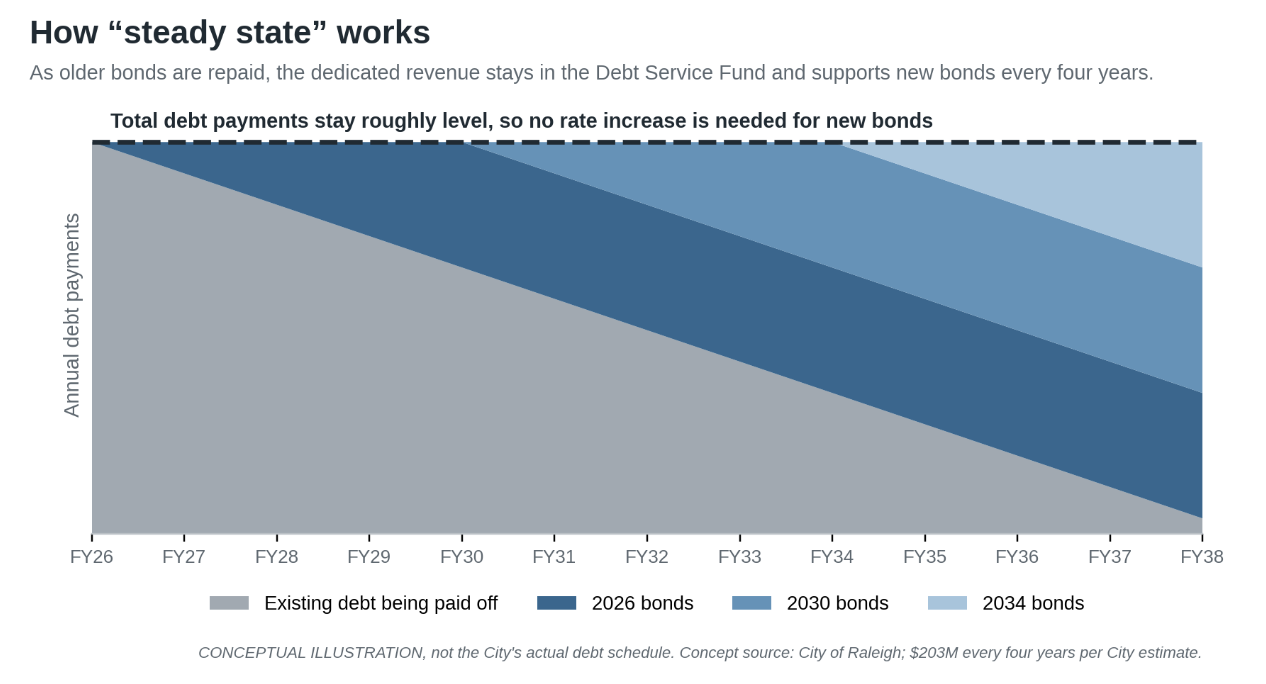
The approach also improves planning. Departments can design and price projects before they go to voters, and housing partners can align deals with a predictable four-year funding cycle.
Why Raleigh Should Vote Yes
The case for both bonds rests on planning, need, results and discipline. The region still faces a shortfall of roughly 70,000 homes affordable to renters earning 50 percent of area median income or less. The 2020 bond showed that City dollars, combined with federal tax credits and private financing, produces tangible results. The transportation bond prioritizes designed projects, and the sidewalks, crossings and traffic calming residents ask for every day. And steady state lets Raleigh make these investments on a predictable schedule without a bond-driven rate increase. Neither bond will solve Raleigh’s housing or mobility challenges, but they do represent practical, fiscally disciplined steps that will improve the quality of life for all current and future Raleigh residents.
Before You Vote
The voter registration deadline is 5 p.m. on October 9. Early voting runs October 15 through 31, and eligible residents who miss the deadline can register and vote the same day at early voting sites. Election Day is November 3. Learn more on the City’s Finance Department page and by visiting VoteYesRaleigh.com.