
February 1, 2026 Newsletter
To receive these updates directly to your inbox, subscribe on Substack.
City Council’s Winter Retreat Recap
Raleigh City Council held its Winter retreat on Friday, January 23 and Saturday, January 24. Due to the weather, the retreat was shortened to ½ day. While the retreat was shortened, it reinforced what seems to be an emerging trend: Raleigh is starting to look for more creative/innovative ways to use its municipal toolbox to deliver better results for residents while still maintaining the City’s financial health. Also, the discussion below related to possible bond packages are staff recommendations. Council will discuss these recommendations as part of its budget process that begins in February. Here are some highlights with links to the presentation for each agenda item:
Budget and Financial Management-Staff focused on increasing budget pressures arising from the need to continue ensuring the City’s pay remains competitive, implementing the recent fire master plan and a fiscal impact analysis to ensure the City aligns its policies with future service and infrastructure needs. Staff also discussed the process for implementing its new “Steady State” bond financing strategy which will allow the City to issue approximately $203 million dollars of bond debt every 4 years without a tax increase. As RaleighForward noted recently, this debt financing technique will help the City better plan things like property acquisitions for affordable housing. It can also facilitate more effective implementation of capital improvement plans and avoid scrapping projects like the Six Forks Road project.
Parking System Update-Staff provided a detailed status report of the state of the public parking system throughout downtown. Key issues discussed was the gap between the rising repair and maintenance needs of the City’s parking decks and current revenue generation. One bright spot was the off-street parking and metering system. Staff will continue studying ways to address the parking deck funding gap and will present another update in March.
2026 Transportation Bond ($103 million)-Staff discussed the possibility of $48 million in bonds to fund road projects that were abandoned under prior transportation bonds due to cost overruns (Trawick and Marsh Creek Road, Ebenezer Church Road) and new general-purpose lanes adjacent to the Southern BRT route). Perhaps most exciting was the possibility of $40 million to add a combination of approximately 5 miles of new sidewalks and up to 50 miles of new separated and protected bike lanes, along with new neighborhood bikeways. Finally, staff recommended another $15 million for enhanced neighborhood safety improvements and advanced real estate acquisition for future projects. The presentation also noted a shift in how the City will implement future bonds to avoid the “abandonment” issue experienced most recently at Six Forks Road. The new strategy will only include projects in future bond packages that have already been subject to advanced planning like partial design and some right of way acquisition. This should allow projects to be packaged more realistically before inclusion in a bond package. Previously, the City did not even initiate any sort of planning for a transportation project UNTIL voters approved a bond. As a result, there was not enough advanced planning to understand what the timing and cost would be for specific projects prior to inclusion in a bond package. This led to frequent project terminations like Trawick Road, Marsh Creek Road, Ebenezer Church Road and most recently, Six Forks Road.
Housing and Neighborhoods ($101 million)-Staff presented a proposal to increase the City’s next housing bond by $21 million but continue with a similar approach to the most recent $80 million bond, with two notable exceptions: adding $12 million for programs related to homeless response and $21 million for a revolving loan fund to implement a new mixed-income housing development fund. The City would allocate $57.6 million for its ongoing housing preservation and gap financing efforts and $10.4 million for homebuyer assistance and repair programs. The revolving loan fund is an entirely new approach to financing new, mixed-income housing based on the model used in places like Montgomery County, Maryland. The City is working with the Center for Public Enterprise (CPE) to help develop this new housing finance model using a revolving loan fund. Council scheduled a February 10 work session where staff will detail the work that it has been doing with CPE.
Urban Land Institute’s Emerging Trends in Real Estate 2026 Forecast for Raleigh?
ULI’s Emerging Trends report frames 2026 as a “high-uncertainty” year where costs (labor, materials, operating, insurance), interest rates, immigration policy, and state/local regulation are central constraints on development and investment decisions. Locally, the practical takeaway is policy choices that reduce avoidable friction (time, uncertainty and infrastructure bottlenecks) will matter more than usual because developers and investors are underwriting projects with tighter margins and higher perceived risk.
The Triangle is still a growth magnet, so housing and infrastructure remain key issues. The report singles out the Triangle as one of only a few Sun Belt metros still attracting strong domestic migration at levels comparable to the 2021 surge. That implies continued demand pressure on housing and transportation systems even as national growth cools. At the same time, the report warns that working-age population growth is slowing sharply due to aging demographics and changes in immigration. The report estimates the U.S. needs net immigration of at least 280,000 per year through 2028 to prevent declines in the working-age population. Locally, that combination (in-migration + tighter labor markets) reinforces a core policy priority: ensure cities can add housing supply efficiently while also supporting the construction workforce pipeline.
Multifamily will not “snap back” quickly and affordability politics will continue. The report expects slow rental growth to persist into 2026 (and possibly beyond), even though long-run housing shortages remain. Multifamily starts fell by more than 40% from 2023 to 2025, reflecting high material costs, interest rates, and market worries. Meaning today’s slowdown can become tomorrow’s shortage (like what Raleigh experienced after the Great Recession) if the pipeline stays constrained. It also explicitly notes the affordability gap is pushing households to smaller, lower-cost places and “prompting policymakers at all levels to devise strategies to deliver more housing.” Raleigh should continue looking for ways to diversify and expand housing supply (especially “missing middle”), shorten the entitlement timeline, and align planned growth with infrastructure capacity and public investments as it develops its next Comprehensive Plan.
Two continuing trends have direct implications for Triangle municipalities: data centers and senior housing. Data centers are rated the top subsector, but the report highlights “immense power and water requirements,” noting that construction often begins before power capacity is fully secured. That points to the potential need for early, coordinated planning with utilities on substation/transmission capacity, water/sewer constraints, and clear siting/permitting expectations. Meanwhile, senior housing demand is expected to surge as boomers turn 80, with the sector described as underbuilt and facing capacity limits. Local land use policy can either enable this needed supply in appropriate locations or inadvertently push it into fewer, higher-cost sites.
Downtown office and fiscal resilience: plan for continued uneven recovery and reuse limits. The report notes downtown office prices are down about 50% from peaks, vacancy is still rising as large occupiers right-size, and “distressed sales” are increasing. Importantly, it cautions that conversions of obsolete office buildings often are not practical for many owners due to physical and financial constraints. It also argues that “unsafe city” narratives are often disconnected from crime statistics, citing declines in violent and property crime and very low 2024 rates nationally. For Raleigh, that suggests downtown strategies should be grounded in market reality: support targeted reinvestment and safety perception management, but the office-to-residential conversion is likely not a scalable fix to the downtown office market softness.
Bottom line for policy makers: Raleigh’s comparative advantage (continued migration and job growth expectations) will persist. However; to remain competitive, Raleigh must continue addressing housing production, infrastructure sufficiency, transit and transportation, predictable entitlement processes and long-term fiscal and climate resilience.
RaleighForward’s Founder, Eric Braun, named to City’s Comprehensive Plan Technical Advisory Team for Housing Policy
The City continues to take a creative approach to developing its next Comprehensive Plan. As we have written previously, Raleigh is using a Civic Assembly for the first time as one of several tools for engaging residents across the City in this important planning effort. Additionally, City Council appointed a variety of subject matter experts dispersed across 5 technical teams covering: Land use; transportation; housing and neighborhoods; natural resources; and infrastructure and services. Each team will meet approximately 6 times and work with the City’s professional staff to develop specific policy recommendations that will ultimately be incorporated into the final draft Comprehensive Plan document. Prior to these efforts, the City conducted listening sessions and traditional engagement efforts to gather resident input about concerns and priorities that will also inform the content of the next Comprehensive Plan.
Articles of interest this week:
Ghosts of the Past: Restrictive Covenants and Their Impact on Raleigh’s Urban Equity. This research paper explores Raleigh’s history with racial covenants and how Neighborhood Conservation Overlay Districts may perpetuate racial segregation, while Missing Middle reforms can help mitigate the lingering effects of racial covenants and exclusionary zoning practices.
While “Missing Middle” housing is currently the hot topic, this essay from 2021 has an interesting take on a different kind of housing: “Missing LARGE” housing.
Even plans to add mixed-income housing on top of a public library is controversial. In Wealthy Chevy Chase, Divisive Plan to add Housing to Library.
Will 2026 be the Year that Homes Finally Become Affordable? (podcast)
Competitions Bring Much Needed New Thinking to Stale Housing Industry.
Why NIMBY’s Hate Housing (podcast)
How Sociotropic Aesthetic Judgments Drive Opposition to Housing Development. This research details how aesthetic judgments account for a certain amount of opposition to new housing development.
Do Housing Supply Skeptics Learn? Evidence from Economics and Advocacy Treatments
Folk Economics and the Persistence of Political Opposition to New Housing. This research paper suggests that U.S. housing is restricted partly because homeowners can block projects through local discretion, while renters are less organized. State or regional control could bypass NIMBYism, but surveys show only 30–40% think more supply lowers prices. Many instead blame landlords and developers, complicating supply-expansion plans.
This Skinny Mexico City Tower Is Just 14 Feet Wide on One Side. The mixed-use building Ferrocarril de Cuernavaca 780, designed by the architecture firm HEMAA, rises on a sliver of a parcel between a street and a rail line.
From the Data Department:
Triangle Ranks #11 in Overall Real Estate Market in 2026 (up 1 spot from 2025).
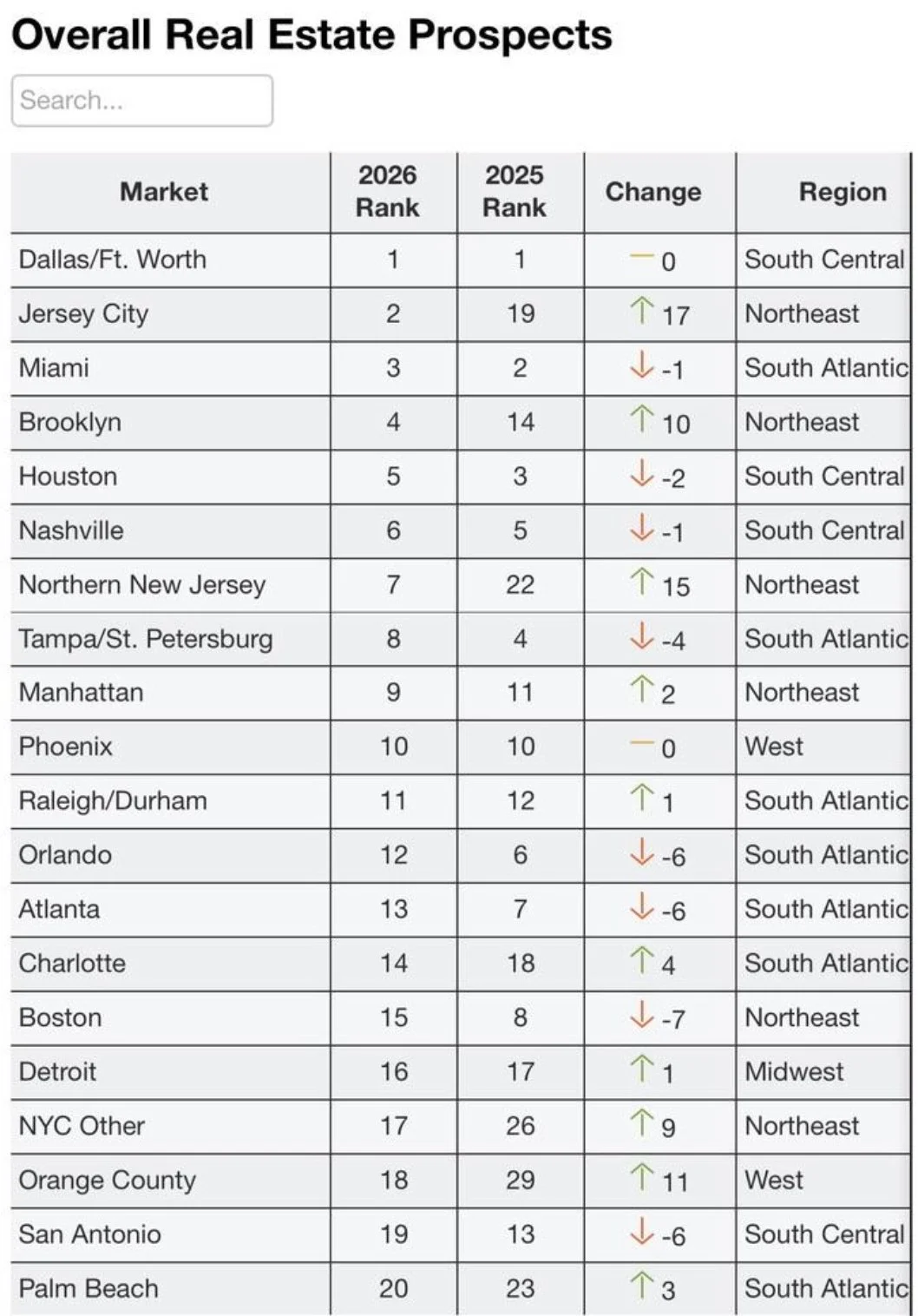
Chart courtesy of Urban Land Institute’s Emerging Trends in Real Estate 2026
Raleigh City Council’s next meeting is February 3, 2026.
Other items of interest:
Council will conduct a work session on February 10 at 4:00 focusing on a mixed-income housing model like what Montgomery County, Maryland has used to build rental housing units that are generally 70% market rate and 30% affordable for people making 60% of Area Median Income and below. The model does not involve direct public subsidies but rather creates a revolving loan fund and takes advantage of the preferred tax treatment of the Raleigh Housing Authority. See the discussion above under the Council Work Session Recap.
Raleigh will be conducting electoral information sessions to help inform the public of changes to how and when City Councilors are elected. Remember that there is a City Council primary election on March 3 and early voting begins on February 13, 2026. If you are interested in attending one of the City’s electoral informational sessions, click here.
Click here for the latest City Manager Report.