
May 17, 2026 Newsletter
To receive these updates directly to your inbox, subscribe on Substack.
ADU Professional Training
Join RaleighForward, WakeUP Wake County, CITYBUILDER and the City of Raleigh for a workshop introducing architects and builders to ADU design, permitting, and sustainable construction methods. The workshop will be held on Saturday, June 6th from 9am to noon.

ADU Sustainability Tour
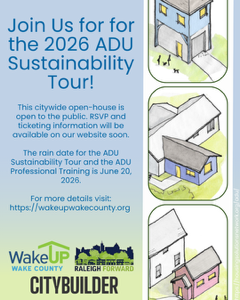
CITYBUILDER, WakeUP Wake County, and Raleigh Forward are excited to announce the 2026 ADU Sustainability Tour! This is a citywide open-house event celebrating thoughtfully designed, energy-efficient, and context-sensitive small-scale housing built after Raleigh’s 2020 text change.
This tour will feature Accessory Dwelling Units (detached, attached, garage conversions, and internal units) and Tiny Homes.
The tour date will be Saturday, June 6th, from 1-5 pm, with a rain date of June 20th. RSVP here.
Articles of interest this week:
The Wake County Continuum of Care released the results of the 2025 Point In Time (PIT) count. The PIT count is a national effort where all Continuum of Care organizations across the country attempt to count the number of people experiencing homelessness during the same period every January. If you are interested in exploring the results of the 2025 PIT count, click here.
Housing and homelessness research generally demonstrates that housing supply and affordability directly impact the degree to which people struggle with housing insecurity in any given community. To try and help readers understand this complex social and economic challenge, we put together the following list of recently published research for consideration.
Housing Supply, Affordability & the State of Housing
Joint Center for Housing Studies of Harvard University. (2025).The State of the Nation’s Housing 2025. Harvard University. The annual benchmark for U.S. housing market conditions — documents record-high prices, rising cost burdens for 20+ million owner households, and the climate-driven insurance squeeze.
Glaeser, E. L., & Gyourko, J. (2025). “America’s Housing Supply Problem.” Brookings Papers on Economic Activity, Spring 2025. Demonstrates that the long-run collapse in construction rates — even in formerly affordable Sun Belt metros like Phoenix and Miami — is the root driver of today’s affordability crisis.
Joint Center for Housing Studies of Harvard University. (2024).America’s Rental Housing 2024. Harvard University. The companion volume to State of the Nation’s Housing focused on rentals; documents the record share of cost-burdened renters and the policy implications for vouchers, LIHTC, and supply.
Mast, E. (2023). “JUE Insight: The effect of new market-rate housing construction on the low-income housing market.“ Journal of Urban Economics, 133, 103383. A landmark “migration chains” study showing that even luxury new construction frees up units down the income ladder — central evidence in the “filtering” debate.
Goolsbee, A. D., & Syverson, C. (2023). “The Strange and Awful Path of Productivity in the U.S. Construction Sector.” NBER Working Paper No. 30845. Documents the decades-long stagnation (and decline) in construction productivity — a crucial and underappreciated driver of high housing costs.
Zoning Reform & Land Use
Greenaway-McGrevy, R., & Phillips, P. C. B. (2023). “The impact of upzoning on housing construction in Auckland.” Journal of Urban Economics, 136, 103555. The most rigorous causal estimate to date of how broad citywide upzoning expands supply — Auckland produced ~45% more permits than its synthetic control.
Hartley, J. (2024). “Does Upzoning Affect Housing Supply and Affordability? Evidence From Minneapolis 2040.” SSRN Working Paper. An early U.S. evaluation of the country’s first citywide elimination of single-family-only zoning; relevant to states and cities considering similar reforms.
Horowitz, A., & Staveski, A. (2024). “Minneapolis Land Use Reforms Offer a Blueprint for Housing Affordability.” The Pew Charitable Trusts. An accessible policy brief showing Minneapolis rents grew just 1% (vs. 31% nationally) from 2017–2023 after broad supply-side reforms; widely cited by state legislators.
Garcia, D., & Alameldin, M. (2024). “California’s HOME Act Turns One: Data and Insights from the First Year of Senate Bill 9.” Terner Center for Housing Innovation, UC Berkeley. A sobering look at why California’s headline single-family upzoning law has produced almost no units useful for understanding the gap between zoning text and on-the-ground outcomes.
From the Data Department:
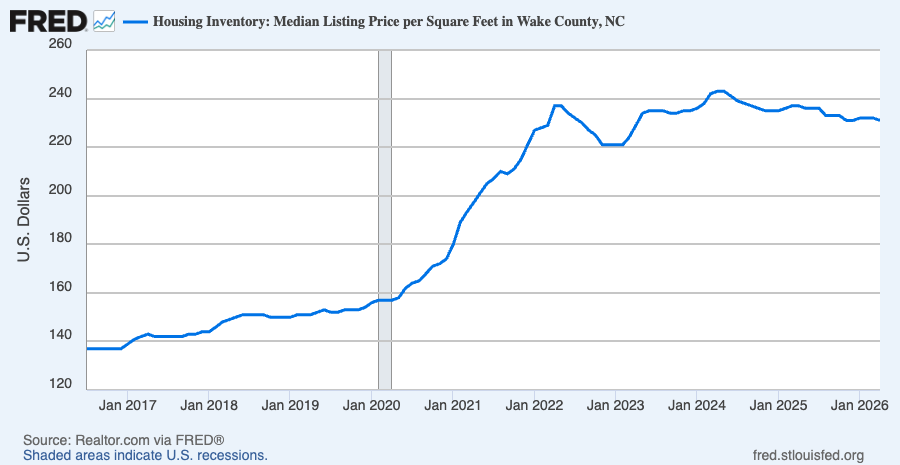
The Wake County Median Listing Price per square foot is starting to moderate:
Raleigh City Council’s next meeting is Tuesday, May 19, 2026. Here are a couple of items to keep an eye on:
Staff will present Council with 2 recommended routes for the northern leg of Raleigh’s Bus Rapid Transit system. Council will be asked to endorse these recommendations as the City works to obtain Federal funding to continue work on this portion of Raleigh’s emerging bus rapid transit system. Click here for the agenda backup.
Staff will present the City’s proposed operating and capital improvement budget for the next fiscal year. Thereafter, Council will conduct budget work sessions in June, prior to approving the budget prior to July 1. Click here for details.
Council will conduct a public hearing for a proposed $203 million housing and transportation bond to be split evenly between those two proposed uses. If Council votes to advance the bond package, it will vote to place it on the November 2026 ballot. Click here for additional details.
Council will conduct a public hearing on rezoning case Z-37-25 involving approximately 9 acres located at the intersection of Avent Ferry and Chappell Drive, near NCSU campus. The request involves changing the current zoning from Residential-10 and Residential Mixed Use-3 stories to Residential Mixed Use 5 stories. If approved, the property could be developed with up to 478 residential units, 8,000 square feet of retail and 8,000 square feet of office. Planning Commission voted 8-0 to recommend approval.
Council will conduct a public hearing for rezoning Z-39-25, which seeks to rezone about ½ acre from Residential 10 with an NCOD to Residential Mixed Use 4 stories Conditional Use (and removal of the NCOD). The rezoning will increase the number of allowed residential units from 10 to 52. Planning Commission voted 6-2 to recommend approval.
Other items of interest:
Click here for the latest City Manager Report.
Under One Canopy: Supporting Roots and Roofs in Wake County
RaleighForward joined WakeUP Wake County and other local groups to host “Under One Canopy: Supporting Roots and Roofs in Wake County. The event highlighted the important of our urban tree canopy and had dozens of attendees. Expert panelists shared a number of recommendations, including:
Strong tree policies should be grounded in data that clearly demonstrates the physical, environmental, and social benefits that a healthy urban tree canopy provides to communities.
Encouraging compact growth in appropriate locations can help reduce development pressure on the outskirts of cities, where large areas of existing tree cover are often lost to new infrastructure and expansion.
Participation in the City of Raleigh’s Leaf Out program offers communities a practical way to support and expand the long-term health of Raleigh’s urban tree canopy.
Residents can make a meaningful impact at home by improving soil health and prioritizing native trees and plantings over turf grass and non-native species.