
July 19, 2026 Newsletter
To receive these updates directly to your inbox, subscribe on Substack.
RaleighForward in the news.
RaleighForward Founder Eric Braun was recently quoted in two News & Observer articles:
NC just ended most parking requirements for developers. Here’s what it could mean.
Eric Braun, a retired land‑use attorney and founder of RaleighForward, said the reforms let developers focus on design instead of squeezing projects around outdated requirements. It also creates opportunities to shape projects that “better fit within the fabric of existing neighborhoods.”
News & Observer, July 15, 2026
New federal housing law aims to improve affordability. Will it help the Triangle?
Eric Braun, a retired land-use attorney and founder of RaleighForward, highlighted reforms to the HOME and Community Development Block Grant (CDBG) programs, which Raleigh already relies on to finance affordable housing and neighborhood investment. Allowing CDBG funds to support new construction, he said, could immediately strengthen the city’s existing efforts.

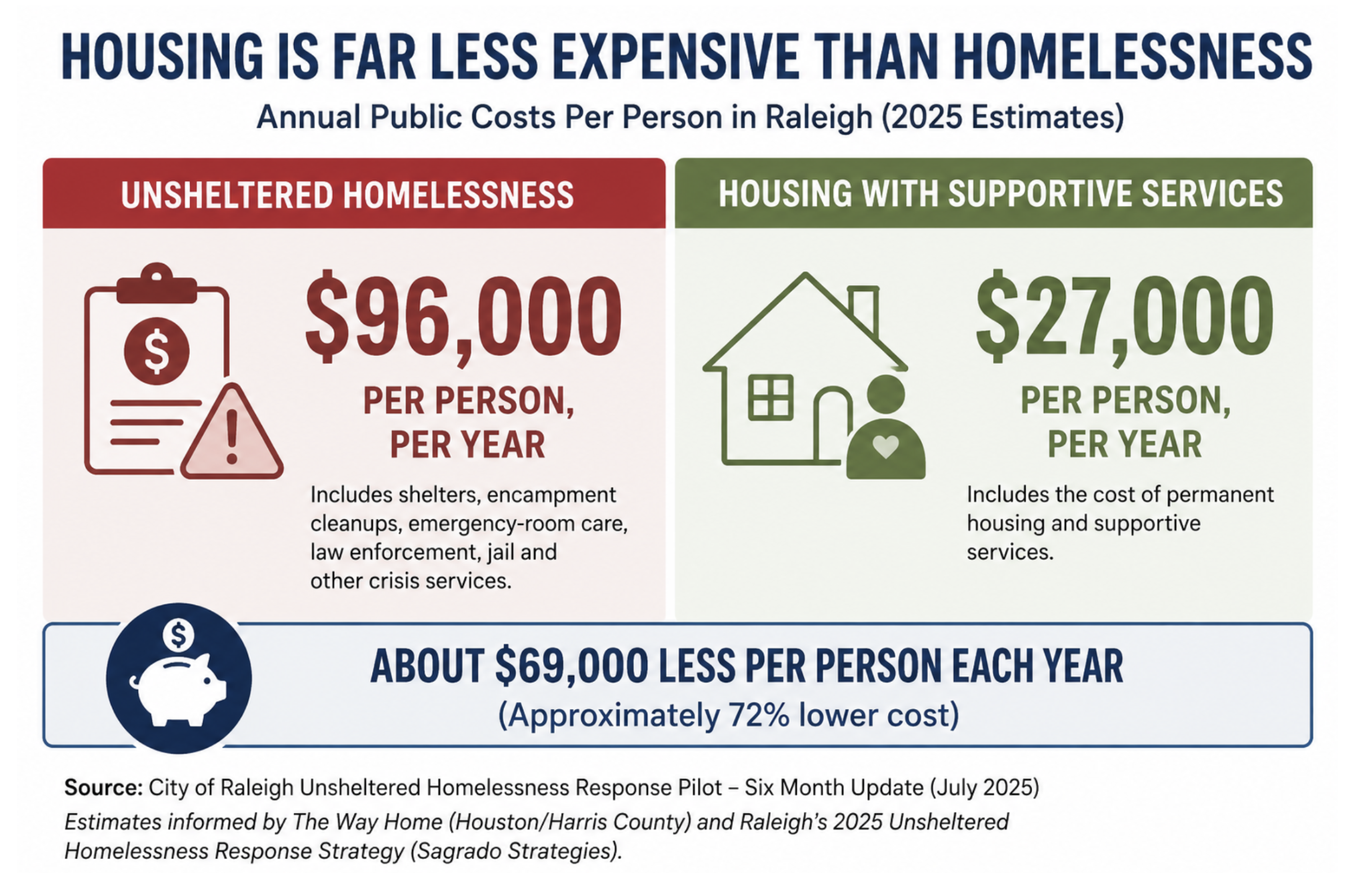
Wake County Continuum of Care Announces a Public/Private Partnership to Tackle Homelessness and Encampments using Housing First Model
What Is Housing First?
Housing First rests on a simple premise: stable housing is the foundation for addressing the problems that accompany homelessness. Developed by psychologist Sam Tsemberis through Pathways to Housing in New York City in 1992, the model moves people directly into permanent housing without requiring sobriety, treatment participation, employment or other preconditions. Once housed, participants are offered services tailored to their needs. In other words, the approach is designed to offer a full ecosystem of services from street outreach to supportive housing that allows for progressive engagement and cost effective interventions.
The approach reverses the older “staircase” model, under which people were expected to progress through shelters, complete treatment programs and find employment before becoming eligible for permanent housing. Too often, people with the greatest needs are unable to complete that sequence. The evidence supporting the success of the Housing First model is substantial. Pathways reported housing retention rates of 85 to 90 percent. One federally funded randomized study found that 80 percent of Housing First participants were stably housed after twelve months, compared with 24 percent of participants in conventional staircase programs.
Communities That Made It Work
Success should be measured through clearly defined outcomes and objective data. In the Housing First context, the clearest benchmark used to define success is when a community reduces homelessness to a level called “functional zero.” Functional zero is reached when homelessness for a defined population becomes rare, brief and resolved as quickly as new cases occur, with progress verified through real-time data.
Rockford, Illinois, became the first U.S. community to reach functional zero for both veteran and chronic homelessness. Abilene, Texas, later reached functional zero for veterans and for people experiencing chronic homelessness. Across the country, at least fourteen communities have functionally ended homelessness for at least one population. Houston’s regional initiative, The Way Home, has placed more than 32,000 people in permanent housing since 2012 and reduced homelessness by more than 60 percent since 2011. This represents one of the largest reductions achieved by any major American metropolitan area.
Wake at Home: Applying the Model Locally
The Wake County Continuum of Care is now applying these principles through Wake at Home, a coordinated public-private initiative led by the Wake County Continuum of Care and its governing board. The initiative is vitally important since unsheltered homelessness in Wake County has more than doubled since 2020.
Wake at Home will begin with a targeted effort to resolve homeless encampments by connecting people sleeping outdoors with housing, health care, employment assistance and other support needed for long-term stability. The initiative builds on local programs like Wake County’s Bridge to Home and Raleigh’s Unsheltered Homelessness Response Pilot. The planned first phase, extending through December 2027, involves an initial investment of approximately $22 million from public and private sources.
The initial goals are ambitious and measurable:
• Connect 400 people living in encampments to housing and supportive services, then restore and monitor the affected public spaces.
• Help 1,000 people experiencing homelessness for the first time return quickly to housing through targeted financial assistance and rapid-resolution strategies.
• Provide intensive care coordination for people experiencing homelessness who have complex behavioral-health needs.
These goals reflect an important feature of Housing First: communities must intervene before people have experienced years of homelessness. Modest, short-term assistance with security deposits, temporary rent support or family reunification often prevents a temporary housing crisis from becoming long-term homelessness. Wake at Home combines encampment resolution with prevention and rapid rehousing, while building the community’s systemic capacity to reach and sustain functional zero.
Keys to Success
Communities that achieve measurable results tend to share several features. They maintain a reliable, frequently updated list of people experiencing homelessness, so service providers know who needs assistance and whether new entries into homelessness are outpacing housing placements. They coordinate housing providers, health systems, nonprofits, local governments and the Veterans Administration rather than operating parallel and overlapping programs. They also build a sufficient housing pipeline through landlord recruitment, risk-mitigation funds and dedicated affordable or supportive housing.
Housing placement alone is not enough. Services, while voluntary, must be offered persistently and remain easily accessible after a lease is signed and a person is housed. Finally, successful programs require durable political and community support. Wake at Home’s stated emphasis on measurable outcomes, cross-sector coordination, prevention and supportive services aligns with these lessons. Its long-term success depends on transparent reporting, a dependable supply of housing and diverse, sustainable funding beyond the initial phase.
The Challenges of a Shifting Federal Landscape
In the near-term, communities implementing Housing First initiatives face rising uncertainty at the federal level. A July 24, 2025, executive order directed HUD and HHS to move away from federal support for Housing First and emphasized encampment enforcement and mandatory treatment participation. HUD subsequently proposed limiting the share of Continuum of Care funding available for permanent supportive housing while directing more funding toward transitional programs with work or treatment requirements. A federal judge blocked that overhaul in January 2026, and Congress later directed HUD to preserve substantial funding for permanent supportive housing and rapid rehousing in the FY2026 funding process.
The practical lesson for the Wake County Continuum of Care and supporting local governments across the County is that federal policy often changes faster than local programs can be redesigned. A resilient homelessness system therefore needs diversified funding, clear performance data and adequate local capacity to continue effective work even when federal priorities shift.
The Road Ahead
The evidence supporting Housing First has not disappeared because of shifting political priorities. The experiences of Rockford, Abilene and Houston demonstrate that homelessness is not an intractable condition of American cities. Communities can reduce homelessness when they use reliable data, coordinate their systems, provide enough housing, remain focused on measurable outcomes and cultivate sustainable financial resources.
Permanent resolution to unsheltered homelessness requires tangible rehousing options paired with supportive services and collaborative engagement with closure and enforcement teams.
Wake at Home offers an opportunity to apply these lessons at a meaningful scale in our own community. Its goals are not simply to move encampments out of sight, but to help people move from the streets into stable housing and prevent new episodes of homelessness from becoming chronic. The initiative should be judged by whether it achieves those results during the initial surge, and then whether it can leverage those results into systemic, long-term program sustainability.
Be on the lookout for additional information as the Wake at Home program rolls out across Raleigh and Wake County. There will be volunteer opportunities, as well as opportunities to contribute financially to leverage the public investments already committed to the effort. Achieving Functional Zero will not be easy, but we can do it with ongoing support of local governments, businesses, nonprofits and private philanthropy. Let’s go!
Sources and Further Reading
Pathways to Housing. “Supported Housing for Street-Dwelling Homeless Individuals With Psychiatric Disabilities”
“Is the Housing First Model Effective? Different Evidence for Different Outcomes” (American Journal of Public Health / PMC).
Community Solutions – Functional Zero definition and Built for Zero results.
Community Solutions - What does it mean to achieve functional zero for all populations?
Next City - How an Illinois City Achieved Functional Zero (Rockford)
Smart Cities Dive - Houston’s Housing First model is reducing homelessness
Coalition for the Homeless of Houston – 2024 Point-in-Time Count results
Wake County Bridge to Home program helps thousands secure stable housing
Community Solutions – Eight lessons from communities that functionally ended veteran homelessness
White House- Executive Order: Ending Crime and Disorder on America’s Streets (July 24, 2025) -
National Low Income Housing Coalition – Analysis of the executive order
Community Solutions - The Impact of HUD’s 2025 NOFO
National Coalition for the Homeless - Statement on HUD’s FY2026 CoC NOFO
Shelterforce - Judge Blocks HUD’s Effort to Overhaul Federal Funding for Homeless Services (January 2026)
National Association of Counties - Congress directs HUD to renew expired CoC projects and sets FY2026 NOFO requirements
Wake County Continuum of Care - Wake at Home initiative announcement (July 2026)
Housing First: A review of the Evidence from HUD
From the Data Department:
Wake County’s median cost of real estate increased by $10,000 in May to $475,000.