
To receive these updates directly to your inbox, subscribe on Substack.
Editor’s Note: RaleighForward is facing our end of year fundraising crunch and to keep bringing you this type of content, we need to raise $5,000 by the end of the year. Your donations will help RaleighForward continue providing these newsletters, programs like the local polling, as well as insider information on housing and other issues at the City of Raleigh. Reach out or reply to this email if you are interested in supporting our work! Or make a direct donation now on our website.
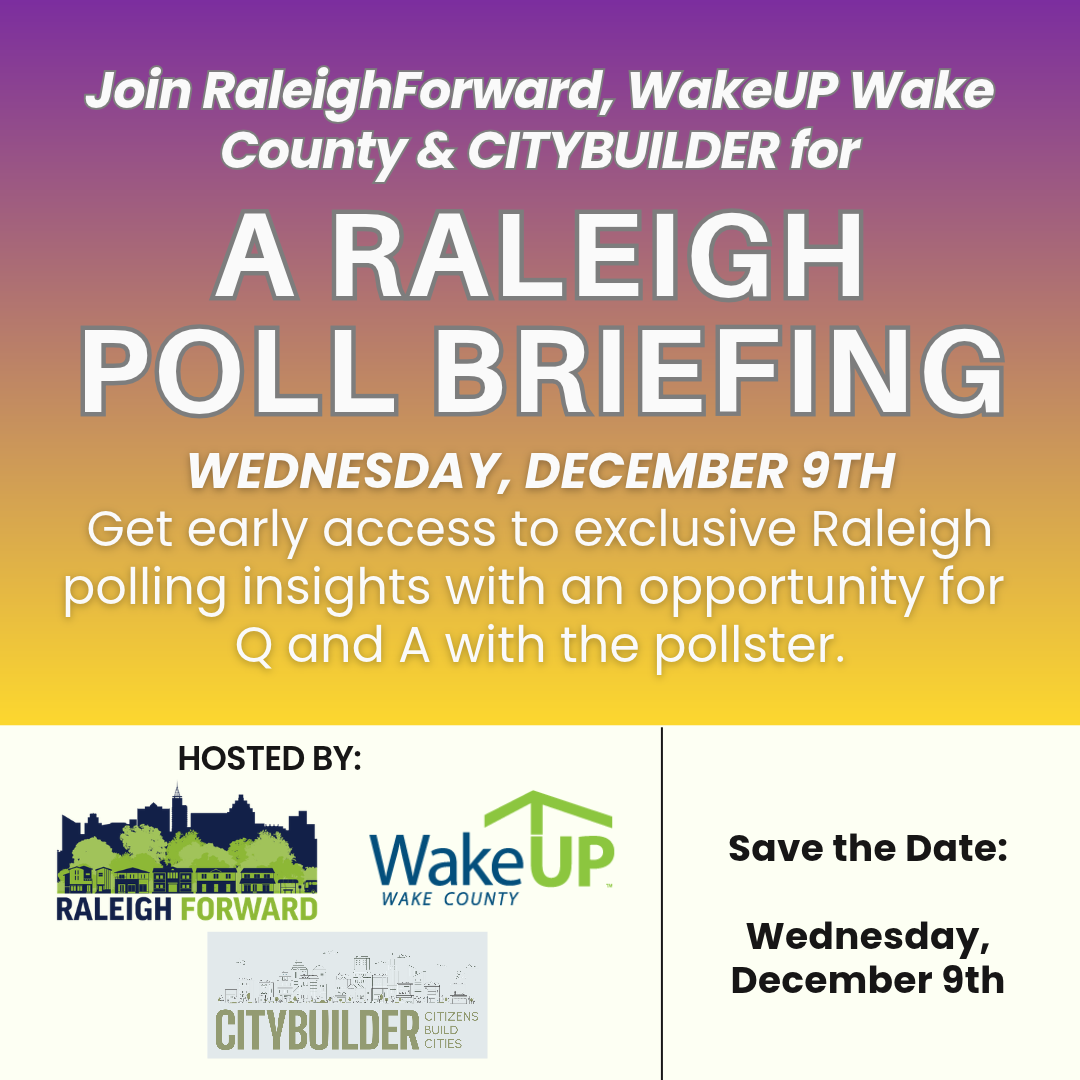
RaleighForward will be sharing details about the time and location soon. Keep an eye on your inbox for updates!
Two Bonds, One Ballot: What Raleigh’s Housing and Transportation Bonds Would Fund, and Why They Don’t Require a Tax Increase
Editor’s Note: This is a lightly edited version of an article published by RaleighForward earlier this year in light of Election Day on Tuesday.
Housing and transportation are two issues that impact Raleigh residents every day and are key priorities in Raleigh’s Strategic Plan. On November 3, voters will have a direct say in how Raleigh invests in both.
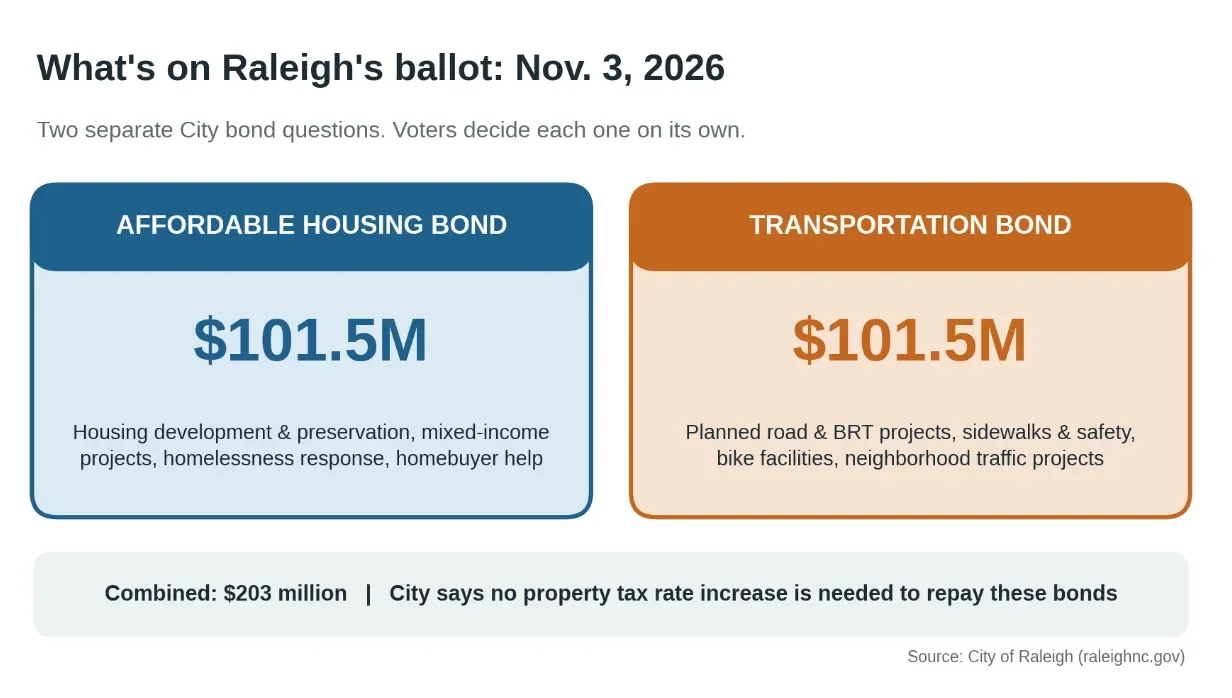
Raleigh’s November 3 ballot includes two City bond questions: a $101.5 million Affordable Housing Bond and a $101.5 million Transportation Bond. Each question is decided separately.
Together, the bonds authorize $203 million in borrowing, and according to the City, that debt can be repaid without raising the property tax rate. Understanding why requires a look at the ballot itself, the projects, and a financing approach the City calls “steady state.”
Reading the Ballot
North Carolina law prescribes the wording of every general obligation bond question. Each will state that additional property taxes may be levied to repay the bonds, then list two estimates: the cumulative cost of the bonds, calculated using the highest interest rate charged on similar debt over a look-back period equal to the maximum bond term, and the tax liability per $100,000 of property value. Here is how the City Bond language appears on the Ballot:
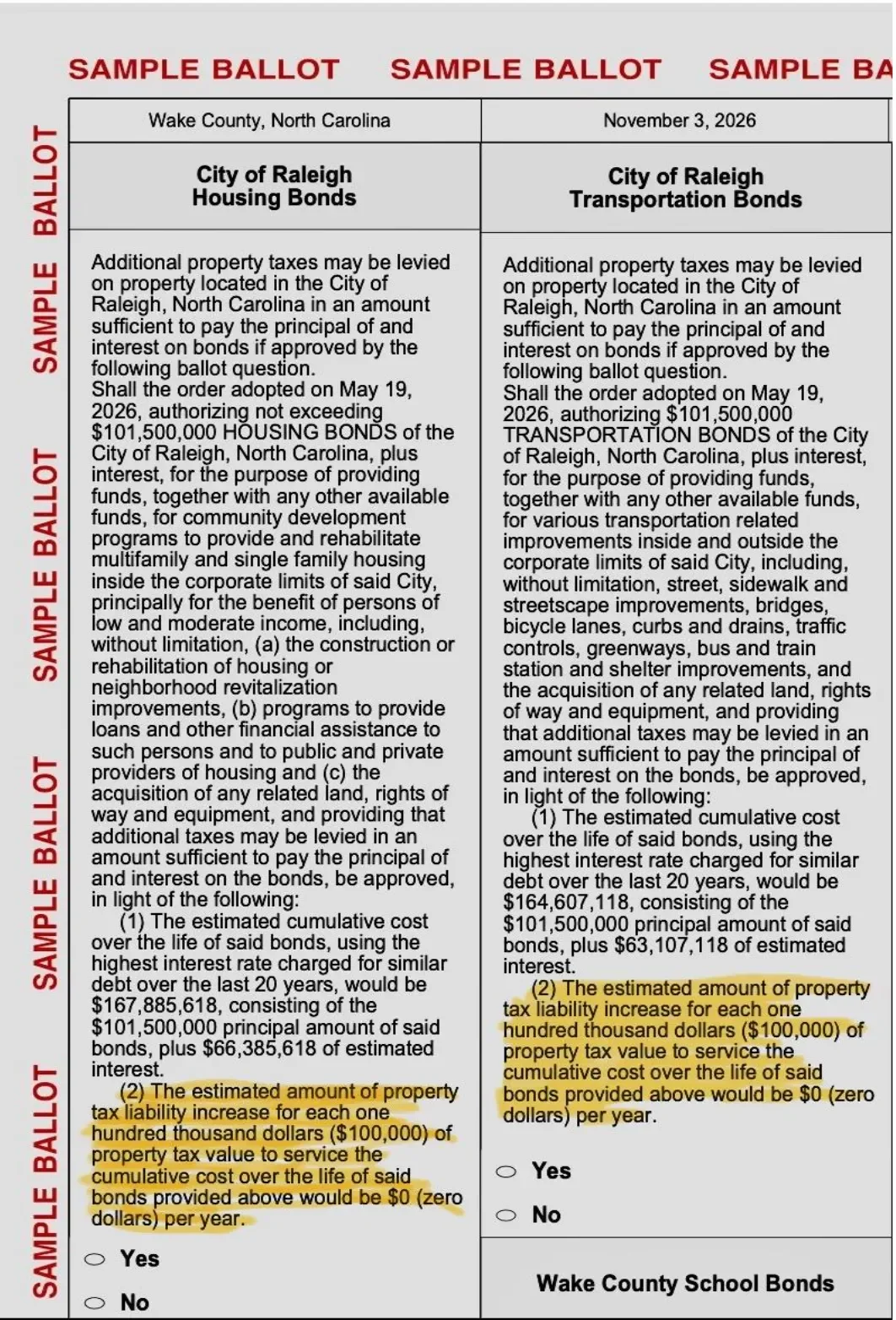
That language is required on every general obligation bond because the City’s taxing authority guarantees the debt, whether or not a rate increase is planned. Raleigh voters will also see separate Wake County questions for public schools and Wake Tech, which carry their own estimated county tax impact.
The Affordable Housing Bond
As Raleigh grows, housing affordability has become one of the most pressing challenges facing the City.
The proposed Housing Bond will help create and preserve affordable housing, help residents become homeowners or remain in their homes as they age, support mixed-income development, and strengthen Raleigh’s response to homelessness.
The bond provides about $25.4 million annually from FY2027 through FY2030, 58 percent more per year than the 2020 bond. That $80 million bond, approved by 72 percent of voters, helped build or preserve nearly 2,500 affordable homes.
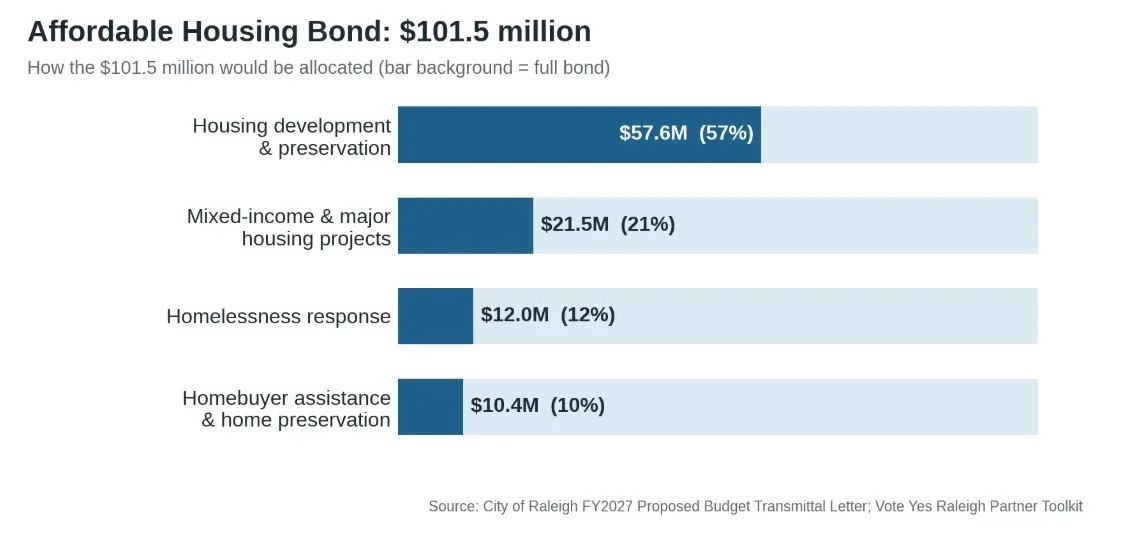
Housing development and preservation ($57.6 million). Gap financing for new income-restricted housing, preservation and rehabilitation of naturally occurring affordable housing.
Mixed-income and major projects ($21.5 million). Seeds a loan fund for mixed-income developments. Housing Director Emila Sutton told Council roughly one-third of units in these projects would be affordable, and repaid loans would be relent to future projects.
Homelessness response ($12 million). Supports the Wake at Home unsheltered homeless response initiative, building on a 2024 rent-assistance pilot that enrolled 45 households.
Homebuyer assistance and home preservation ($10.4 million). Down payment assistance for eligible first-time buyers, repairs that keep existing owners in their homes and help for seniors who want to age in place.
For a growing city, housing is an economic issue. When teachers, first responders, healthcare workers, service employees and young families can afford to live closer to where they work, Raleigh benefits from stronger neighborhoods, a more accessible workforce and shorter commutes.
The Transportation Bond
Growth also puts increasing pressure on Raleigh’s transportation infrastructure. The proposed Transportation Bond funds improvements to roads, sidewalks, intersections, bridges, bicycle infrastructure and other connections residents rely on every day.
The goal is not simply to build more infrastructure, but to make it easier and safer for people to move around Raleigh whether they are driving, walking, biking or using transit.
That also reflects the direction established in Raleigh’s Strategic Plan, which calls for closing gaps in the sidewalk and bicycle networks, improving safety for pedestrians and cyclists, and making transportation investments that support the city’s continued growth.
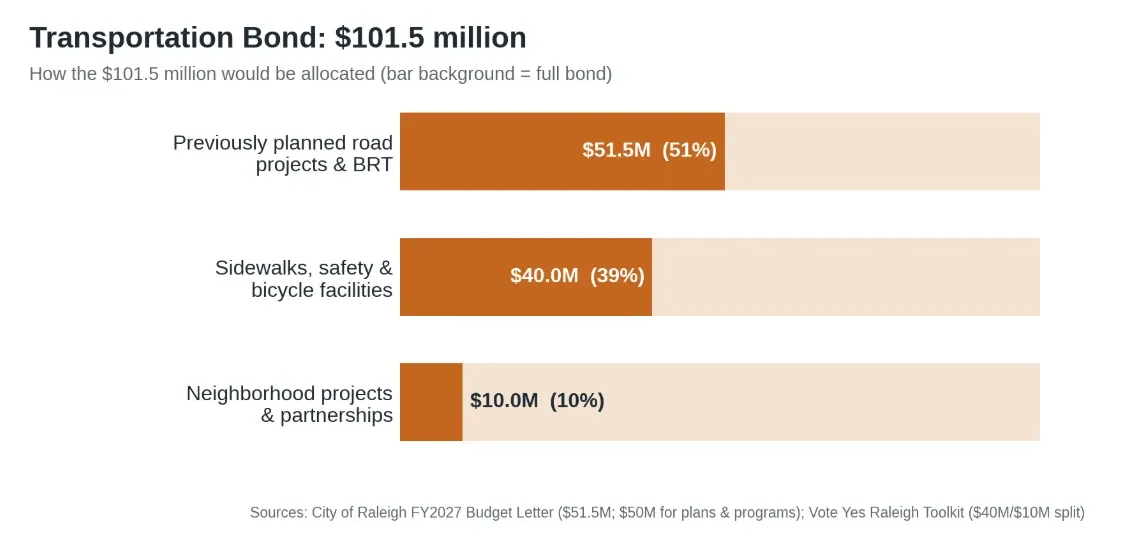
Previously planned projects and Bus Rapid Transit ($51.5 million). Designed projects that are closer to construction, including three deferred from the 2017 bond (Marsh Creek Road, Trawick Road-West and Ebenezer Church Road), plus general-purpose lanes associated with BRT.
Sidewalks, safety and bicycle facilities ($40 million). Advances the Active Mobility Plan’s “Big Jump,” a goal of five miles of sidewalks and 50 miles of high-comfort bikeways in five years, along with safety improvements.
Neighborhood projects and partnerships ($10 million). Funds traffic calming and intersection safety, on neighborhood streets as well as partnerships that support existing planned projects.
For the transportation bond, safety is the throughline. In April, Council adopted a Comprehensive Safety Action Plan aiming to cut fatal and serious-injury crashes in half by 2040. City data show crashes involving pedestrians, cyclists or scooter riders are more than four times as likely to cause death or serious injury.
How “Steady State” Works
Historically, new Raleigh bonds came with tax increases. The 2017 transportation bond carried up to a 1.29-cent increase, and the 2022 parks bond was projected to add 3 to 4 cents.
In FY2026, the City adopted a steady-state model that sends dedicated tax revenue directly to its Debt Service Fund. As older bonds are paid off, that revenue stays dedicated to debt rather than being freed for other uses, and the resulting capacity supports new borrowing. The City estimates that capacity at $203 million every four years without raising taxes.
Council member Megan Patton likened it to a household budget: once a car loan is paid off, the same monthly payment can cover a new roof without changing the overall budget.
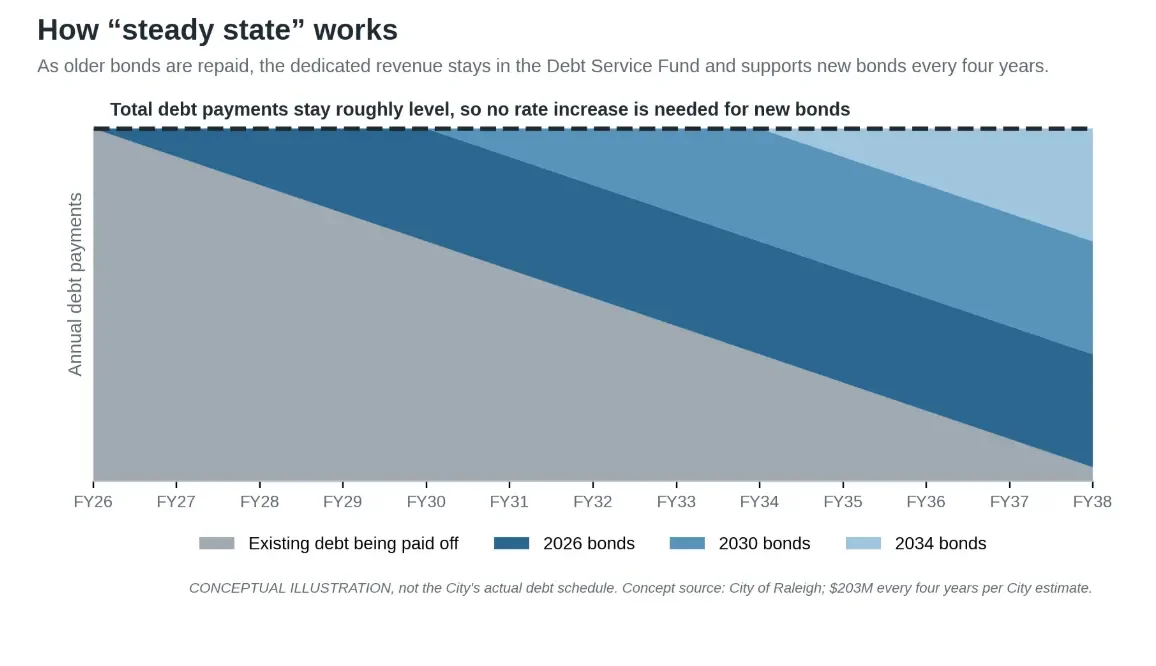
The approach also improves planning. Departments can design and price projects before they go to voters, and housing partners can align deals with a predictable four-year funding cycle.
Why Raleigh Should Vote Yes
The case for both bonds rests on planning, need, results and discipline. The region still faces a shortfall of roughly 70,000 homes affordable to renters earning 50 percent of area median income or less. The 2020 bond showed that City dollars, combined with federal tax credits and private financing, produces tangible results. The transportation bond prioritizes designed projects, and the sidewalks, crossings and traffic calming residents ask for every day. And steady state lets Raleigh make these investments on a predictable schedule without a bond-driven rate increase. Neither bond will solve Raleigh’s housing or mobility challenges, but they do represent practical, fiscally disciplined steps that will improve the quality of life for all current and future Raleigh residents.
Before You Vote
Election Day is Tuesday, November 3. If you have not already voted, vote at your assigned polling place between 6:30 a.m. and 7:30 p.m. Anyone in line at their assigned polling place at 7:30 p.m. can vote. Find your polling place and review Election Day guidance on the State Board of Elections website. Learn more about the bonds on the City’s bond referendum page.
Vote No on the 3 Constitutional Amendments on the November 3 Ballot
Also on the ballot are 3 Constitutional amendments that will hamstring the State and local governments’ ability to manage their fiscal responsibilities effectively. Here are a variety of columns and editorials laying out reasons to consider voting against each of them:
RaleighForward, CityBuilder and WakeUp Wake County are co-hosting YIMBYTOWN Raleigh 2026 from November 17-19. For more information and to purchase your tickets, click here. There are now also one day ticket options for those who cannot attend the entire conference.
Additionally, if you are interested in being a volunteer for YIMBYtown 2026, you can apply here (Deadline is November 1).
Annual Reception
Save the Date for the WakeUp Wake County, RaleighForward and CITYBUILDER Annual Reception this December:
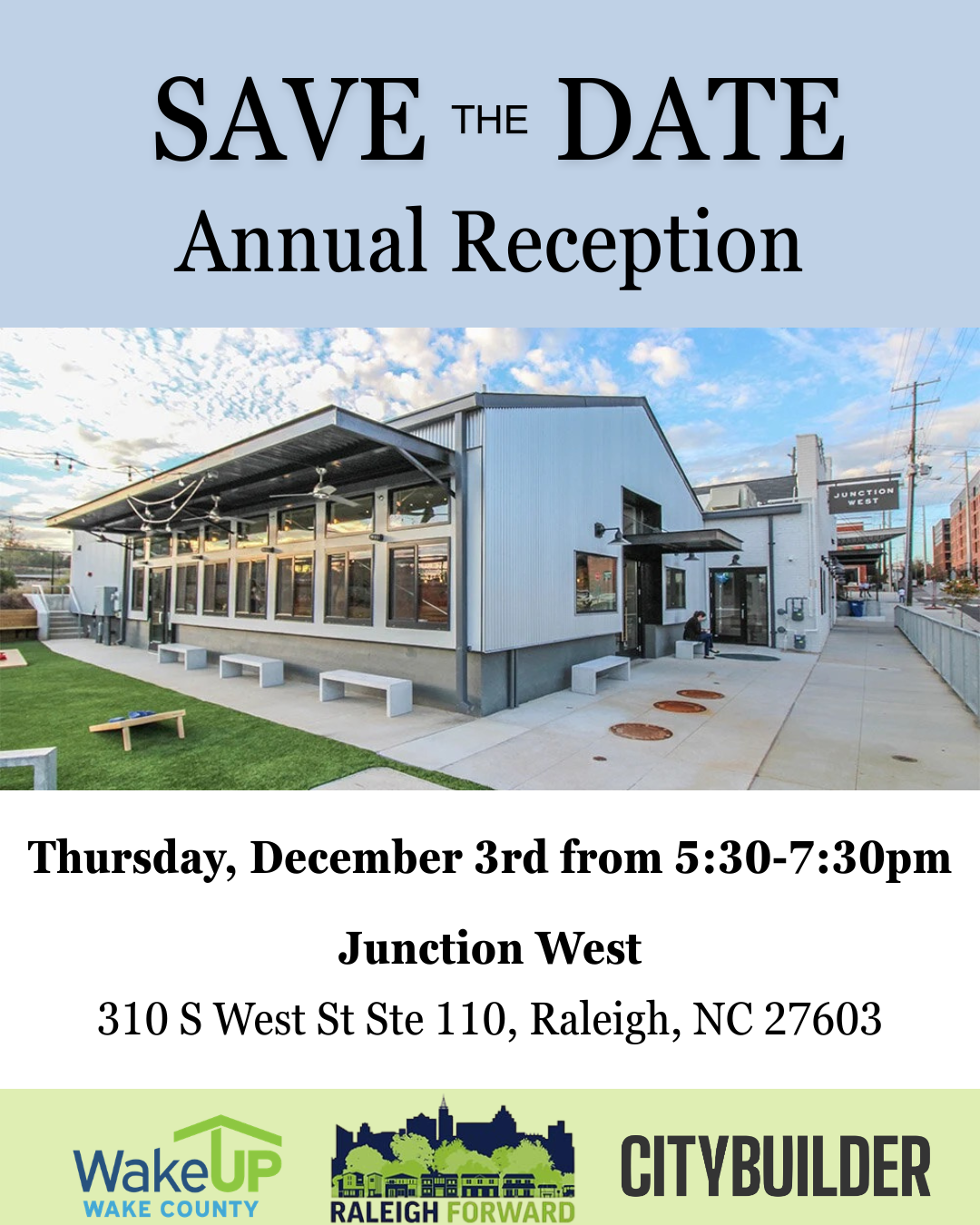
The Annual Reception is on Thursday, December 3, 5.30 – 7.30 at Junction West in downtown Raleigh. There will be time for socializing over heavy hors d’oeuvres, and beer, wine, and refreshments from the bar. WakeUP Wake County’s Executive Director Bert Fox will report on the Regional Coalition and plans for education and advocacy priorities in 2027.
This year’s theme is Planning the Affordable City.
If you are interested in sponsorship opportunities for the annual reception, you can reach out to Eric@RaleighForward.org.
WakeUP Wake County has some interesting events coming up regarding Accessory Dwelling Units:
November 12th, 2026
ADU Community Workshop from 5:30 pm - 7:30 pm at John Chavis Memorial Park Reception Hall, rooms 205 and 206.
During this event, community members will have the opportunity to meet with architects and builders and listen to a presentation about ADUs, which will be given multiple times throughout the evening.
This event is kid-friendly, and refreshments will be provided!
This is a free event, however, please RSVP for our planning purposes.
November 14th, 2026
Community ADU Tour from 1 pm - 3 pm at Walk Your Plans Raleigh
During this drop-in event, attendees will be able to walk through various ADU floor plans, speak with fellow community members, and hear from multiple housing-focused organizations.
This is a free event, however, please RSVP for our planning purposes.
RSVP Here: https://givebutter.com/community-adu-tour
Articles of Interest:
Housing Expert: Affordability Crisis, Declining Immigration are Slowing Demand for Housing.
How CASA Turned an Aging Triplex into Housing for Post-Foster Care Youth.
NC Chapter of the American Planning Association Explores Case Studies on Housing Across NC.
Wake County Approves Potential Property Exchange to Support Affordable Housing.
Three Triangle-area Housing Pilots Offer NC Blueprints for Adults with Disabilities.
Beyond Affordable Housing: Integrating Civic Infrastructure in US Mixed-Use Developments.
From the Data Department:
Axios Raleigh: Interest rates continue to weigh on home purchases.
Why it matters: With more homes on the market, Raleigh buyers could be getting additional negotiating room, according to data from Homes.com.
City Council’s next meeting is Wednesday, November 4, 2026. (Note the day change due to the election.) Here are a few items of interest:
Council will conduct a public hearing for Z-21-26. This is a request to rezone about 2.93 acres at 2905 Hodge Road from Wake County.Residential-30 (R-30) to Raleigh Residential-10 (R-10). The property sits on the east side of Hodge Road at Scenic Woods Drive, about 0.6 miles south of Poole Road. Annexation petition AX-18-26 is being reviewed at the same time. Raleigh R-10 zoning would apply only if City Council approves the annexation.
The applicant says the property is meant to connect with the nearby Banks 20 development. Banks 20 borders the property to the south and east and is also across Hodge Road to the west. To the north are county-regulated homes and the Valley Woods manufactured home park. Since there is no development plan or zoning conditions with this request, coordinated development with Banks 20 is intended but not guaranteed.
The request is consistent with the 2030 Comprehensive Plan.
The request is inconsistent with the Future Land Use Map.
The request is consistent with the Urban Form Map.
The Planning Commission recommends approval of the request (6-2).
Council will conduct a public hearing on Z-22-26. The property is an assemblage of about .93 acres located at 409, 411, 415, 417 Bragg Street and 1106, 1108, 1112, 1114, 1118, and 1120 South East Street.
Current zoning: Residential-10 with South Park Neighborhood Conservation Overlay District (R-10 w/NCOD)
Requested zoning: Residential-10-Conditional Use (R-10-CU)
Signed zoning conditions provided on May 13, 2026, require a minimum front yard
setback between eight and thirty feet, a front entrance facing the primary street,
limiting the view of upper-story entrances from the public right-of-way, and restricting parking to the side or rear of the building.
The request is consistent with the 2030 Comprehensive Plan.
The request is consistent with the Future Land Use Map.
The request is consistent with the Urban Form Map.
The Planning Commission recommends approval of the request (7 – 3).
Other Items of Interest:
Are you interested in helping our community address unsheltered homelessness? If so, the Wake County Continuum of Care is seeking volunteers to serve on its Governing Board. The application process can be found here. Applications are due no later than 11:59 on Monday, November 2.
Current City Manager’s report can be found here.