
June 14, 2026 Newsletter
To receive these updates directly to your inbox, subscribe on Substack.
Our Collaboration with WakeUP Wake County + CITYBUILDER
RaleighForward, WakeUp Wake County and CityBuilder Continue building an Effective Model of Collaboration.
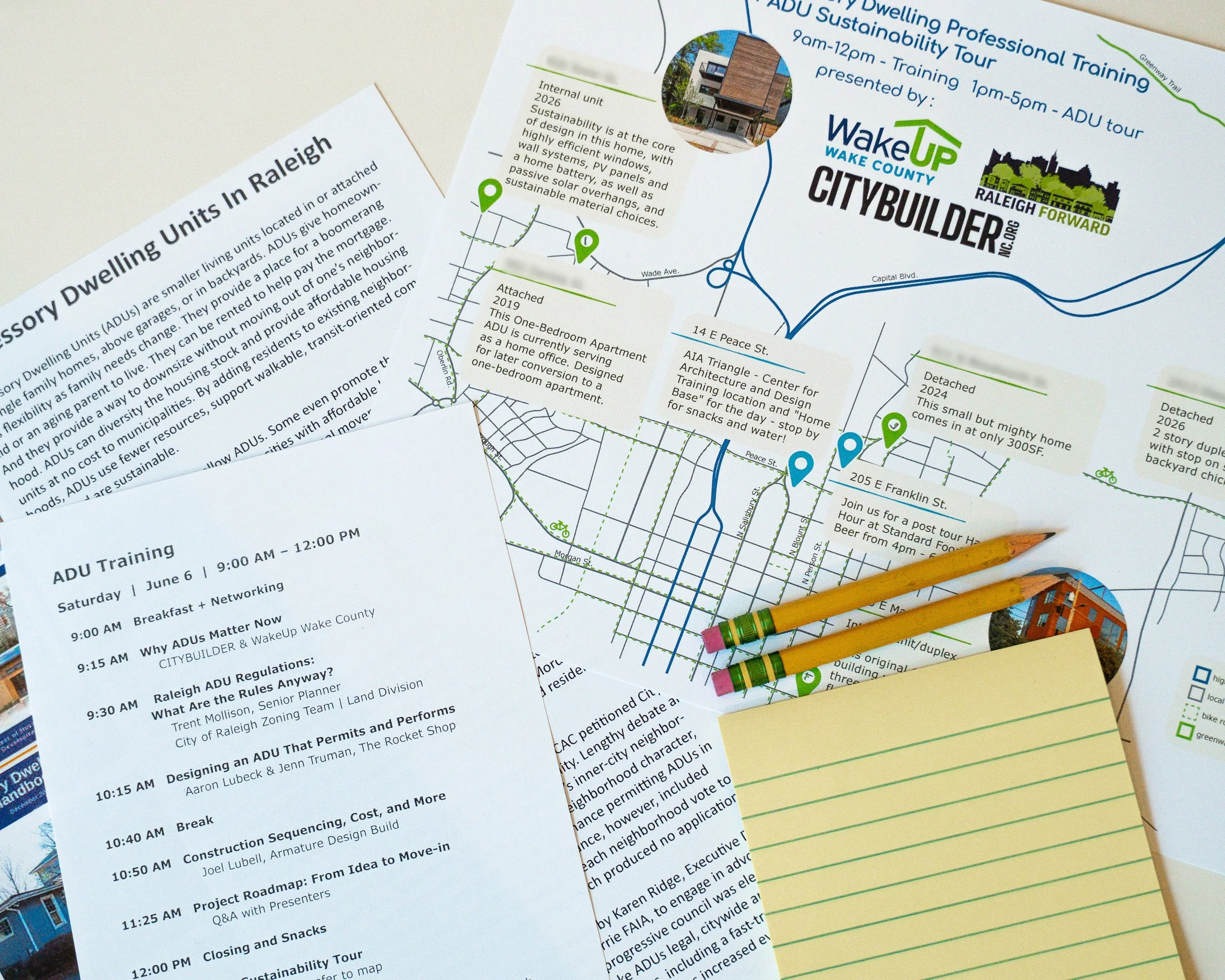
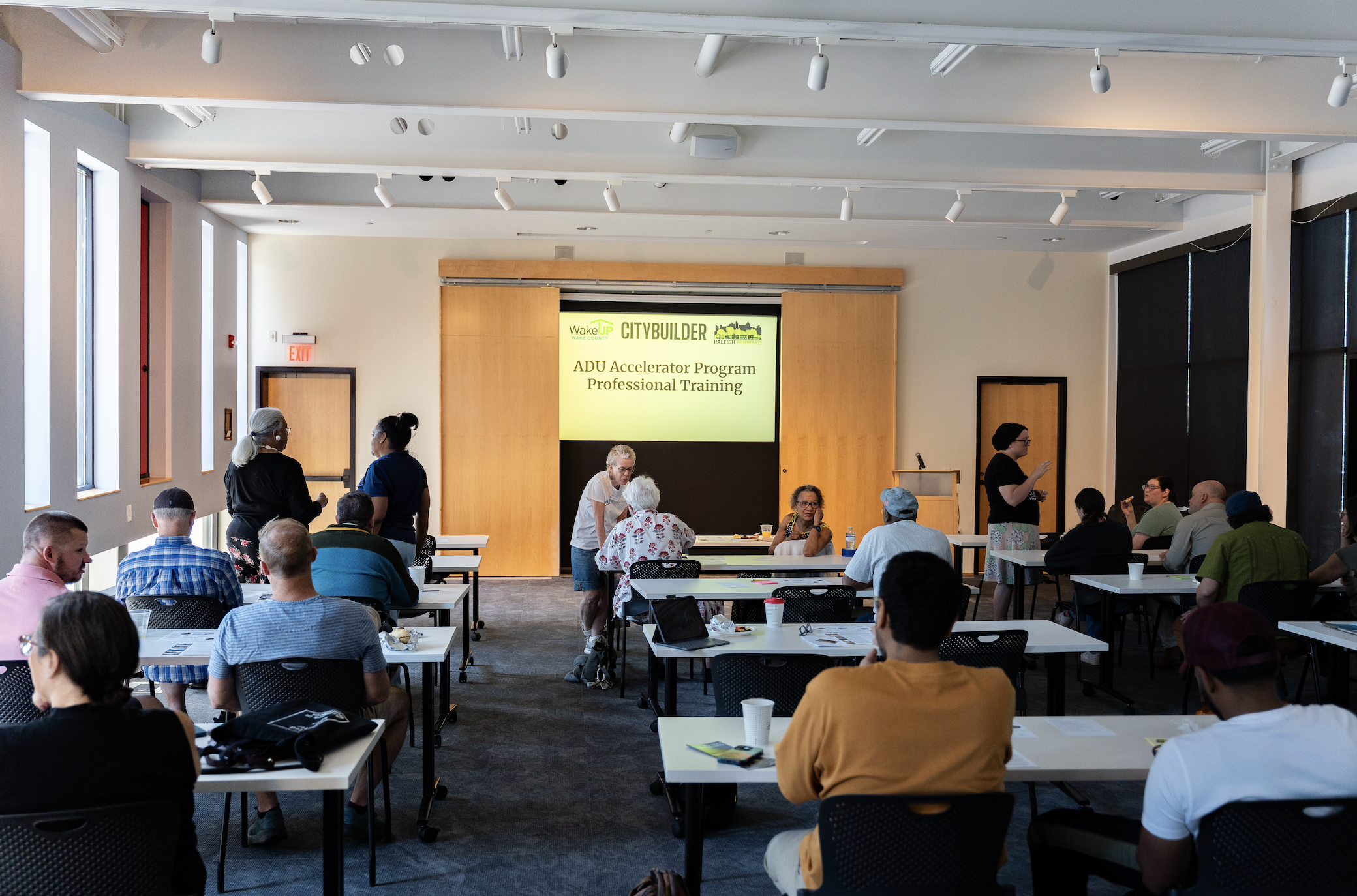
Last Saturday, WakeUP Wake County, in collaboration with RaleighForward and CITYBUILDER, hosted an ADU Accelerator Program Professional Training. In addition to educational presentations from our amazing speakers, fruitful conversations took place amongst community members. Following our training, an ADU Sustainability Tour was held across Raleigh, including five different accessory dwelling units.
We want to extend a huge thank you to our guest speakers, those who volunteered to allow people into their ADU, and to everyone who participated in our events and took the time to learn about ADUs, how to create them, their benefits, and the permitting process!
These events were made possible thanks to the City of Raleigh Impact Partner Grant Program!
Articles of interest this week:
One of the most effective ways cities can grow is through regulatory reforms that encourage small-scale, incremental development. In this newsletter, we identified a variety of articles and research papers related to this issue:
Surveying Missing Middle Trends in the US and Massachusetts — Harvard Joint Center for Housing Studies (April 2025)
First in Luke Tomasso’s three-part series, tracing how middle-scale housing became “expensive because it is illegal,” documenting how parking minimums, minimum lot sizes, and unit caps limit what homes can be built and where, while highlighting incremental reform successes like Northampton’s decades-long zoning evolution.
Building Missing Middle Housing: Recommended Tools Beyond Policy Reform — Harvard Joint Center for Housing Studies (2025)
Tomasso’s follow-up proposes six actions beyond zoning (innovations in financing, advocacy, and construction) to encourage small multifamily production, profiling Austin’s Equitable Development Initiative, a free training program building a pipeline of small, diverse local developers.
Raleigh’s Process Overcomplicates Building Small Homes — City Builder NC (March 2026) Raleigh’s Missing Middle reforms have produced mostly townhomes while the smallest incremental forms (homeowner lot splits and flag lots) remain rare, arguing slow review timelines shut out small-scale builders, with Durham’s roughly one-month plat reviews offered as a contrast.
Preapproved Building Plans Help Cities Improve Housing Affordability — A growing number of mostly small and midsize cities struggling with new housing production have begun providing preapproved building plans to developers as part of a broader effort to lower the cost of building new homes in their communities.
The Power of Small — When most people think of real estate development, they picture big. Big buildings. Big investors. Big cranes. Big risk. But some of the most powerful, community-centered work in real estate doesn’t happen on that scale. It happens on a small lot, with a local builder, a pencil sketch, a tight budget, and a whole lot of vision.
Zoning Reforms and Housing Affordability: Evidence from the Minneapolis 2040 Plan — Gu & Munro, SSRN (July 2025)
A 2025 working paper offering empirical evidence from America’s most-watched citywide upzoning experiment. Minneapolis ended single-family-only zoning in 2020; this study evaluates measurable effects on production and affordability. This study is a good counter to skeptics claiming incremental density reforms don’t move the needle.
Washington Bill would Legalize Low-cost “Co-Living” Homes — Sightline Institute (2026) The remedy for Washington’s dire housing shortage is more homes of all shapes and sizes. Co-living homes—small apartments with shared kitchens—are a low-cost housing option that most communities lack because local zoning laws make them illegal or otherwise impractical to build. A new Washington bill, HB 1998, aims to fix that by setting standards to legalize co-living homes statewide.
The Effects of Residential Zoning in U.S. Housing Markets — Journal of Urban Economics / ScienceDirect (2025)
This peer-reviewed study tackles a longstanding data gap: despite growing empirical literature, the absence of comprehensive zoning data has been a major challenge. It builds on research finding local zoning laws increase housing prices and intensify residential segregation, providing broad national evidence supporting reform.
Reducing Minimum Lot Sizes in Houston, Texas — Bipartisan Policy Center (December 2025)
A case study of America’s most successful small-lot experiment: over 25,000 homes built on lots under 5,000 square feet between 1999 and 2016, with median townhouses on converted lots valued at $340,000 versus $545,000 for comparable new single-family houses. Directly relevant to Raleigh’s lot-standard debates.
Small Single-Stairway Apartment Buildings Have Strong Safety Record — Pew Charitable Trusts (February 2025)
Research showing two-to-19-unit buildings tend to have the most affordable rents, yet only 21% of units built since 2000 fall in this category, partly due to building codes; the study finds sprinklered single-staircase buildings present no higher fire risk than two-staircase construction.
Legalizing Mid-Rise Single-Stair Housing in Massachusetts — A Report on the Impact of Allowing Mid-Rise Point Access Blocks on Housing Design and Development in Greater Boston and Beyond
Unlocking Housing Supply: Mayors’ Views on the Politics of Housing — 2025 Menino Survey of Mayors, Boston University (March 2026) A national survey finding a large and growing majority of U.S. mayors believe increasing supply would reduce housing costs, yet they confront political and institutional barriers limiting their willingness to enact the reforms experts most often recommend. Illuminates why incremental reforms stall locally.
New Homes, Same Old Feel: Sacramento Says Yes to Incremental Development — Strong Towns (March 2025) A narrative case study of Sacramento becoming the first California city to allow multiunit housing in all formerly single-family-only neighborhoods, with community voices explaining the stakes: residents young and old who want to stay in their community but can’t afford to. Accessible storytelling for non-expert readers.
Better Zoning for Reuse and Redevelopment — This issue of Zoning Practice examines how zoning rules and procedures can better accommodate reuse and redevelopment. It begins by summarizing the case for reorienting zoning around previously developed sites before suggesting specific reform strategies that remove zoning barriers to common reuse and redevelopment projects.
Portland’s Inclusionary Zoning Ordinance is Not as Successful as Some Claim (Op-ED) — Inclusionary zoning has failed to live up to its promise of efficiently delivering affordable housing paid for out of developers’ profits. Any honest analysis will demonstrate this.
From the Data Department:
Wake County’s median real estate value decreased by $5,000 to $465,000.
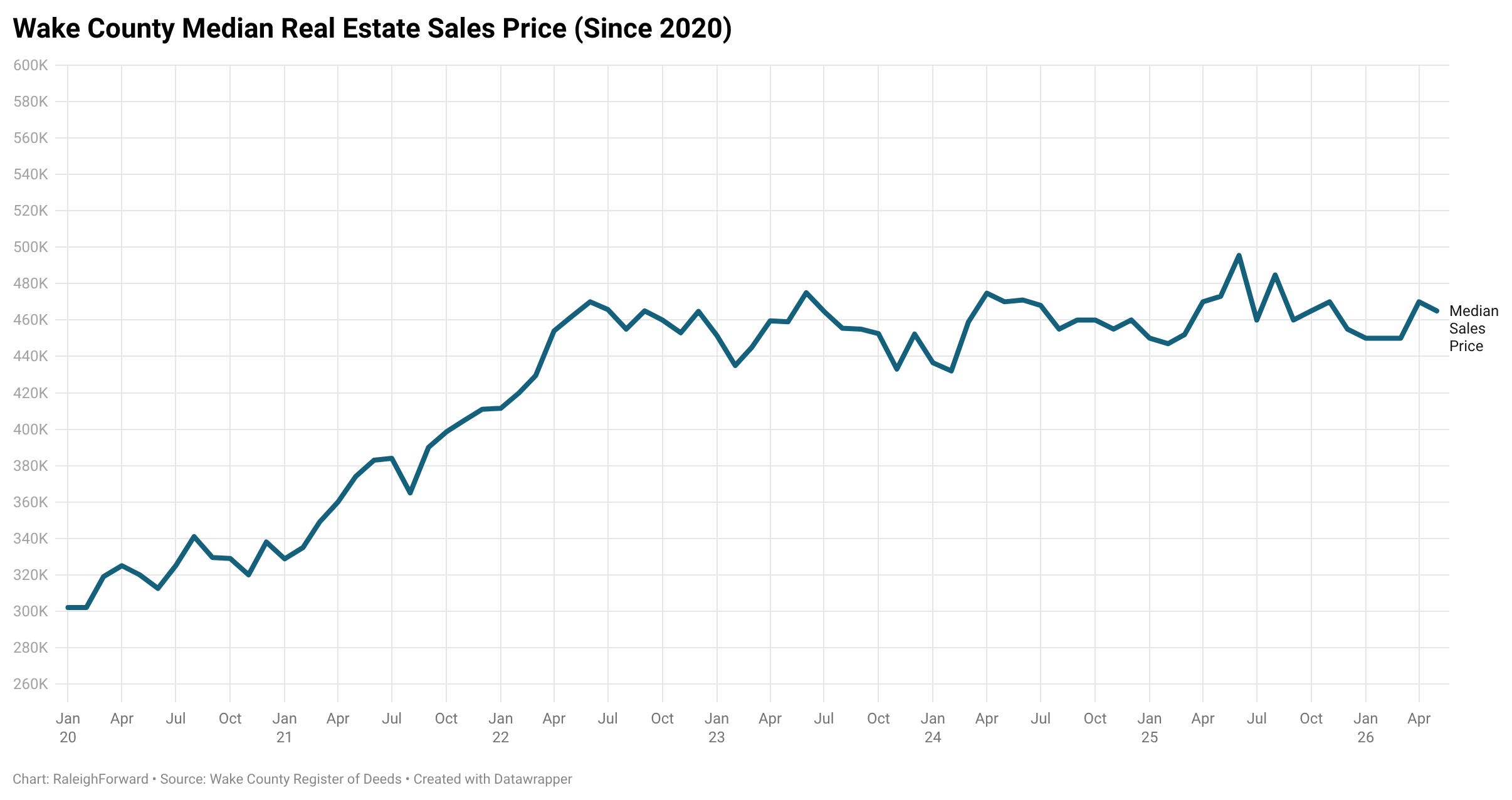
Click the image to visit the interactive version.
Raleigh City Council will hold a work session on Monday, June 15 at 4:00pm.
During the March 4 City Council meeting, Council requested a work session regarding data centers and their potential impacts on local infrastructure. Staff will provide an overview of data centers, including the different types of facilities and the role they play in supporting cloud computing, artificial intelligence, and digital services.
The presentation will also discuss infrastructure requirements including land use, energy consumption, cooling technologies, and water demand; as well as potential economic, environmental, and community impacts. Additionally, staff will provide information regarding the current City regulatory framework, water resource considerations, and other planning considerations that may influence future data center development within the community and surrounding region. Click here for agenda materials.
Raleigh City Council’s next meeting is Tuesday, June 16, 2026. Here are a couple of items to keep an eye on:
Affordable Housing and City-Owned parcels-East Cabarrus Redevelopment
Following a Request for Proposals (RFP) process initiated to identify a development partner for the East-Cabarrus Redevelopment, a total of seven (7) proposals were received in response to the RFP. Proposals were evaluated and the evaluation team recommends Copernica Properties, LLC (d/b/a “Local Post”) as the development partner for this site. Local Post proposes a 28-unit affordable rental development on a cluster of City-owned sites downtown.
Council authorization is necessary to conditionally commit $1,239,762 to Local Post to construct approximately 28-unit affordable rental development for low-income households. City Council adoption of the resolution permitting the City to lease +/- 0.24 acres site to Local Post for a term of no less than 75 years is also requested.Council will continue a public hearing for Rezoning Z-39-25. The request would remove the Neighborhood Conservation District (NCOD), permit additional residential density, and increase allowed building height.
At the May 19, 2026 City Council meeting, the public hearing was held open to allow the applicant to consider revised conditions. Unsigned conditions dated June 5, 2026, provide additional requirements for the Idlewild commemorative plaque, prohibit the Office use, restrict density to 40 units, and limit maximum building height to 55’.
Council will conduct a public hearing for the Rex Hospital Campus Master Plan (Z-48-25). This is a request to establish a Campus Master Plan for Rex Hospital. The Campus Master Plan establishes development standards across the site. Approval of the request would result in a height increase in the central and southwest corner of the site from 12 to 20 stories, a reduction in permitted height in sub-districts that abut residential developments, a reduction in housing entitlement to 500 units, and a reduction in allowed uses.
Council will conduct a public hearing for Z-3-26. This request is to allow for increased building height up to 20 stories and residential and commercial entitlement. The property is located at 617 West Jones and 117 Glenwood Avenue. The request would remove the North Boylan NCOD from 617 West Jones Street.
Council will continue a public hearing for Z-5-26 for multiple properties located along the New Bern Avenue BRT line. This rezoning request would change the zoning for 19 parcels within the vicinity of the New Bern Station Area Plan. These parcels were previously rezoned through a portion of rezoning request Z-92-22. Changes to state law, made effective in late 2024, reverted the zoning districts of some parcels to what they were prior to Z-92-22. As a result, the city organized this new rezoning request that complies with state law.
Other items of interest: