
May 31, 2026 Newsletter
To receive these updates directly to your inbox, subscribe on Substack.
ADU Professional Training
Join RaleighForward, WakeUP Wake County, CITYBUILDER and the City of Raleigh for a workshop introducing architects and builders to ADU design, permitting, and sustainable construction methods. The workshop will be held on Saturday, June 6th from 9am to noon.

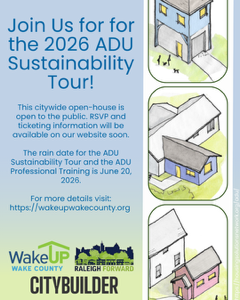
ADU Sustainability Tour
CITYBUILDER, WakeUP Wake County, and Raleigh Forward are excited to announce the 2026 ADU Sustainability Tour! This is a citywide open-house event celebrating thoughtfully designed, energy-efficient, and context-sensitive small-scale housing built after Raleigh’s 2020 text change.
This tour will feature Accessory Dwelling Units (detached, attached, garage conversions, and internal units) and Tiny Homes.
The tour date will be Saturday, June 6th, from 1-5 pm, with a rain date of June 20th. RSVP here.
Articles of interest this week:
Continuing the theme from the last RaleighForward newsletter, we are including an expanded number of articles and research demonstrating how coordinated policies that expand housing supply, provide access to robust supportive services, and address housing affordability (known generally as the “housing first” model) can help communities reduce homelessness to a level called “functional zero.”
Each year, every community conducts a “point in time count” that attempts to determine how many chronically homeless residents live in communities across the country. We included the 2025 PIT Count data in the last RaleighForward newsletter. The 2026 PIT Count results were released by the Wake County Continuum of Care this week.
This data is critical as Raleigh moves forward with a $101.5 million housing bond proposal that includes about $12 million to address homelessness and housing instability. That funding would be combined with Federal, State and Wake County resources to enhance coordinated homeless response strategies through the Wake County Continuum of Care.
Because our community is at an inflection point as we develop plans for addressing housing and homelessness, RaleighForward wanted to provide a comprehensive list of research related to strategies and outcomes. Be on the lookout for more details about an emerging plan to reduce Wake County homelessness to “functional zero.”
Research on Addressing Homelessness
1. Colburn, Shinn, Batko, Galvez, & Kushel (2025). “What Would It Take to End Homelessness in the United States?” Housing Policy Debate. Published April 24, 2025, this article by leading homelessness scholars argues that ending U.S. homelessness is achievable but requires substantial expansion of affordable housing, rental subsidies, and Housing First interventions. The authors synthesize evidence showing that political will and resources remain the primary barriers to solving the crisis.
2. Rao & Brandeau (2025). “Modeling Health and Economic Outcomes of Providing Stable Housing to Homeless Adults With OUD.” JAMA Network Open. Published June 27, 2025, this Stanford/Toronto study uses dynamic mathematical modeling of 1,000 unhoused adults with opioid use disorder. It finds that providing stable housing (without requiring sobriety) is cost-effective, reduces overdoses and mortality, increases treatment retention, and improves quality-adjusted life years compared to a treatment-first status quo.
3. Kim & Painter (2025). “Aging, Housing Affordability, and Homelessness.” Cities. Published August 2025, this peer-reviewed community-level analysis confirms that renting and a higher proportion of older-adult households are strong predictors of U.S. homelessness, especially sheltered homelessness. The interaction of aging populations with rental cost burdens compounds risk, suggesting targeted affordability policies are critical as the population ages post-COVID.
4. Woodhall-Melnik, Monette, Reiser, & LeBlanc Haley (2025). “Housing First for Youth Who Experience Homelessness: A Systematic Review.” Journal of Applied Social Science. This 2025 systematic review synthesizes seven peer-reviewed studies measuring outcomes of Housing First for Youth (HF4Y) programs in the U.S. and Canada. Findings indicate HF4Y improves housing security for youth experiencing homelessness, but the authors caution that the evidence base remains thin and more rigorous outcome research is needed.
5. National Alliance to End Homelessness (2025). State of Homelessness: 2025 Edition Released in 2025, this annual report compiles HUD point-in-time and CoC data, demonstrating that rising rents are the primary structural driver of homelessness: from 2001–2023, median rents rose 23% while renter incomes rose only 5%. It cites GAO findings linking a $100 rent increase to a 9% homelessness rise.
6. Merrefield, C. (2025). “Reducing Homelessness in the U.S.: A Research-Based Explainer.” The Journalist’s Resource, Harvard Kennedy School Shorenstein Center. Published October 8, 2025, this evidence-based explainer reviews peer-reviewed research on what works to move people into permanent housing amid potential federal funding cuts. It surveys Housing First evidence, rapid rehousing, supportive housing, and rental assistance, and explicitly links local housing affordability to homelessness rates.
7. Collins, S. E. (2025). “Housing First: Overview of the Evidence Base.” University of Washington HaRRT Lab. Dated August 30, 2025, this state-of-the-science review summarizes randomized and observational evidence on Housing First, finding consistent benefits for housing stability and health, while identifying risk factors for instability (longer homelessness histories, incarceration, substance use, poor local housing stock) and emerging research on mechanisms of effect.
8. Reid, Martín, Rausch, & Raymond (2025). “What Would It Take to Close the Housing Supply Gap in the Next Five Years, While Addressing the Nation’s Affordability, Climate Sustainability, and Resiliency Goals?” Housing Policy Debate. This 2025 article quantifies the U.S. housing supply shortfall and outlines pathways to close it. The authors connect inadequate housing production to rising rents and homelessness inflows, arguing that supply expansion must be paired with affordability subsidies and climate-resilient design to durably prevent housing loss.
9. Richard, Dworkin, Rule, Farooqui, Glendening, & Carlson (2025). “Quantifying Doubled-Up Homelessness: Presenting a New Measure Using U.S. Census Microdata.” Housing Policy Debate. Published in 2025, this article introduces a Census-microdata-based measure of “doubled-up” homelessness—people sharing housing due to economic hardship. It substantially expands the picture beyond HUD point-in-time counts, demonstrating that hidden housing instability is far more prevalent than shelter data suggest and tightly linked to local affordability.
10. Marr, M. (2025). “Housing First a More Effective Approach to Address Homelessness.” Florida International University. This March 2025 Miami-Dade comparative study by FIU sociologist Matthew Marr contrasts a Housing First model emphasizing rapid placement plus voluntary supportive services against coercive shelter-and-criminalization approaches. The research finds Housing First produces better individual outcomes and is more efficacious at moving people from homelessness into stable housing.
11. U.S. Department of Housing and Urban Development. (2024). “The 2024 Annual Homelessness Assessment Report (AHAR) to Congress, Part 1: Point-in-Time Estimates of Homelessness. HUD Office of Community Planning and Development.” The definitive national count: 770,000+ people homeless on a single night, up 18% from 2023 with family homelessness up 39%.
12. Kushel, M., & Moore, T. (2023). “Toward a New Understanding: The California Statewide Study of People Experiencing Homelessness.” UCSF Benioff Homelessness and Housing Initiative. The largest representative survey of unhoused Americans since the 1990s; participants reported median pre-homelessness income of $960/month, reframing homelessness as a housing-affordability problem.
13. Aubry, T., Bloch, G., Brcic, V., Saad, A., et al. (2020). “Effectiveness of permanent supportive housing and income assistance interventions for homeless individuals in high-income countries: a systematic review.” The Lancet Public Health, 5(6), e342–e360. The most rigorous synthesis of the Housing First evidence base — finds permanent supportive housing reliably improves housing stability, with more mixed effects on health outcomes.
14. MacArthur Foundation (2025). “Using Real-Time Data to Reduce Homelessness” MacArthur Foundation, “A Bold Goal: Ending Homelessness,” Jan. 15, 2025
The MacArthur Foundation profiled Community Solutions’ Built for Zero initiative, which helps communities use real-time, person-specific data to reduce homelessness. The model focuses on making homelessness rare, brief, and nonrecurring. It is useful for explaining why better data systems are not bureaucratic overhead; they are operational tools.
15. Denver’s “All In Mile High” Initiative. The Urban Institute’s evaluation of Denver’s homelessness strategy found that unsheltered homelessness declined by 45% between January 2023 and January 2025. The initiative combined encampment resolution with real indoor alternatives, housing navigation, services, and accountability. The lesson is straightforward: encampments decline when people are offered viable housing pathways.
16. Lessons from Denver’s Encampment Reduction Strategy. A related Urban Institute article explains why Denver’s approach appears more promising than enforcement-only strategies. The city paired outreach and encampment resolution with non-congregate shelter, housing navigation, and permanent housing options. The article is useful because it frames encampment reduction as a housing strategy, not simply a public-space management strategy.
17. Joint Transitional Housing and Rapid Rehousing. Urban Institute’s report on Joint Transitional Housing–Rapid Rehousing programs examines a model designed for people experiencing unsheltered homelessness. The approach combines short-term stabilization, time-limited rental assistance, and supportive services. The report is useful for communities trying to create a bridge from street homelessness to permanent housing without treating transitional housing as the destination.
18. Permanent Supportive Housing Remains One of the Strongest Evidence-Based Tools. Urban Institute summarizes the research base for permanent supportive housing and warns that federal funding shifts away from permanent housing could destabilize existing homelessness response systems. The article is useful because it explains why permanent supportive housing is infrastructure: it helps people with disabilities and long-term homelessness remain housed.
19. Modeling the Consequences of Ending Housing First Support. A 2025 JAMA Health Forum study modeled what could happen if federal support for Housing First programs ended. The authors estimated that homelessness would increase within one year. The study is useful for policymakers because it translates an abstract federal funding debate into a concrete population-level consequence.
20. Stable Housing for Older Adults Experiencing Homelessness. A 2026 JAMA Health Forum article examines the health outcomes and costs associated with providing stable housing to older adults experiencing homelessness. This is especially relevant as homelessness increasingly affects older adults. The policy implication is that housing for seniors is also health policy, aging policy, and fiscal policy.
21. Behavioral Health and Homelessness. UCSF’s research on health and homelessness emphasizes that health problems, behavioral health needs, and homelessness are deeply interconnected. The report supports a housing-centered approach that also expands access to treatment and care. The key lesson is that behavioral health challenges should shape service design, not become a reason to delay housing.
22. Correcting Misconceptions About Drug Use and Homelessness. UCSF’s 2025 research-based summary addresses common assumptions about drug use among people experiencing homelessness. It reports that less than half of surveyed people experiencing homelessness regularly used illicit drugs, and many who did use drugs had tried to access treatment. This supports a more accurate, less stereotype-driven policy conversation.
Raleigh City Council will hold a budget work session on Monday, June 1 at 4:00pm.
Like other counties and cities in the Triangle, Raleigh is proposing a property tax increase. Overall, the Proposed FY 2027 Budget recommends a property tax rate of 37.2 cents - a 1.7 cent increase from FY 2026. This increase, which would cost an additional $67 annually for the median Raleigh household, allows for needed investments to maintain and improve service levels in key areas with a primary focus on public safety. For more information, click here.
Raleigh City Council’s next meeting is Tuesday, June 2, 2026. Here are a couple of items to keep an eye on:
Council will conduct a public hearing on the proposed FY 27 budget. For more information, click here.
Council will continue the public hearing from May 5 for rezoning Z-1-26. Current Zoning: Downtown Mixed Use-5 Stories-Shopfront Frontage (DX-5-SH) & Downtown Mixed Use-20 Stories-Conditional Use (DX-20-CU). Proposed Zoning: Downtown Mixed Use-20 Stories-Conditional Use (DX-20-CU). The request would rezone approximately 1.28 acres of land from Downtown Mixed Use 5 Stories-Shopfront (DX-5-SH) and Downtown Mixed Use-20 Stories-Conditional Use (DX-20-CU) to Downtown Mixed Use-20 Stories-Conditional Use (DX-20-CU). Unsigned conditions received on May 22 prohibit certain uses, include revised historic preservation conditions for the facade of the W Martin Street structure and its upper stories, require one dog waste station and a public plaza be provided in future development, and apply the Main Street streetscape standards to the S Dawson Street frontage. For more information, click here.
Other items of interest:
Click here for the latest City Manager Report.