
August 30, 2026 Newsletter
To receive these updates directly to your inbox, subscribe on Substack.
RaleighForward, CityBuilder and WakeUp Wake County are co-hosting YIMBYTOWN Raleigh 2026 from November 17-19. Time is running out to take advantage of Early Bird ticket pricing, which ends August 31st. For more information, click here.
Raleigh Adopted a New Strategic Plan in 2025. RaleighForward examines how that compares to the City’s Comprehensive Plan:
The City of Raleigh has a variety of different planning documents. They range from housing plans, Transit Plan/Bus Plan, Strategic Plan, Small Area Plans and a Comprehensive Plan. While these plans all are designed to advance key goals established through various public processes, two key plans that drive the City’s future are the Strategic Plan and the Comprehensive Plan. The FY2026–2029 Strategic Plan, approved by City Council in June 2025, establishes seven priorities that will guide City initiatives over the next four years: community safety; economic development and innovation; environmental resilience; housing; organizational excellence; quality of life; and transportation and transit.
The plan deserves attention not simply because of what it says, but because of what it is designed to do. Unlike Raleigh’s Comprehensive Plan, which establishes a long-term vision for how Raleigh should grow and develop, the Strategic Plan focuses on implementation: priorities, initiatives and measurable outcomes for City government. The City describes it as a guide for improving the community that is aligned with other citywide planning efforts.For RaleighForward readers, three areas are particularly noteworthy: housing, transportation and community prosperity.
Housing: Increasing Supply While Promoting Stability
Housing is one of the Strategic Plan’s seven priorities. The City describes Raleigh’s affordability challenge as both a supply and access problem and identifies two broad objectives: advancing approaches that address housing insecurity and promoting walkable, mixed-income communities that expand housing choices while connecting housing with transit and infrastructure. That translates into several significant initiatives. The City proposes to streamline development review, update zoning to allow a broader range of housing, including missing-middle housing and housing near frequent transit, and pursue public-private partnerships that can facilitate housing production.
But the strategy is not limited to increasing supply. It also calls for rental and housing assistance, homelessness prevention and diversion, and preservation of naturally occurring affordable housing. Perhaps most importantly, Raleigh intends to measure results. Indicators of success include housing production across different housing types, the percentage of new housing near frequent transit, housing stability among program participants, and residents’ perceptions of housing choice and affordable-housing availability.
Transportation: Connecting Transit, Land Use and Safety
The transportation strategy similarly goes beyond building roads. Its central objective is improving mobility through more frequent transit, safer walking conditions and better connections among transportation options. Specific initiatives include closing sidewalk and bicycle-network gaps near priority transit routes, accelerating sidewalk projects, improving GoRaleigh reliability and the rider experience, and increasing bus frequency. The plan also recognizes the important relationship between transportation and land use, including the role that zoning and development patterns can play in supporting transit investments. Success will be measured through indicators of success like pedestrian and cyclist injuries and fatalities, GoRaleigh use and ridership, and resident satisfaction with transportation choices.
Community Prosperity: Making Growth Work for More People
“Community prosperity” is not a separate Strategic Plan category, but the concept runs throughout the Economic Development & Innovation and Quality of Life priorities.
The City proposes making it easier for entrepreneurs and small businesses to work with City government by improving contracting and vendor payments, simplifying permitting and support services, coordinating processes across departments, and expanding assistance for small and under-capitalized businesses. The Strategic Plan also recognizes arts and culture as components of economic vitality, including support for creative-sector businesses, public art and cultural programming. Quality-of-life strategies seek to expand access to parks, recreation, arts and cultural opportunities throughout Raleigh.
Strategic Plan vs. Comprehensive Plan: What’s the Difference?
Raleigh has a lot of plans, and the terminology can be confusing. The easiest way to think about the distinction is that the Comprehensive Plan establishes Raleigh’s longer-term vision for growth, while the Strategic Plan helps translate City priorities into nearer-term governmental action.
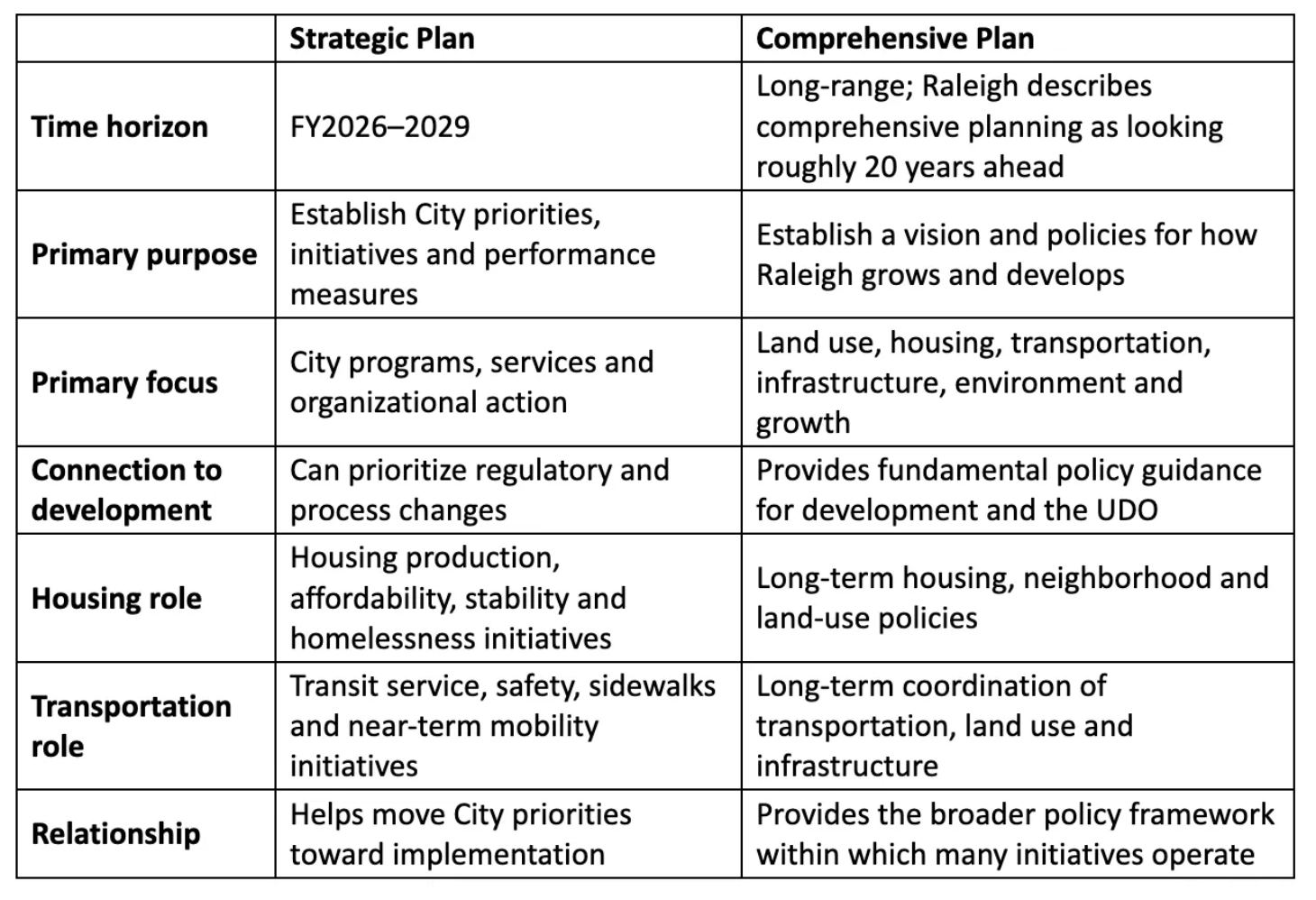
That distinction matters. A Strategic Plan initiative to increase housing near frequent transit, for example, may require changes to zoning, infrastructure investments or development policies that ultimately must fit within Raleigh’s broader land-use framework.
And Raleigh Is Writing a New Comprehensive Plan
The timing is particularly important because Raleigh is simultaneously developing its next Comprehensive Plan through an initiative called Reflecting Raleigh.
The existing 2030 Comprehensive Plan was designed to guide growth through 2030. The new plan will establish the framework for the decades that follow. The City began the process in 2024. During Phase 1, Raleigh reports engaging more than 12,000 community members at more than 90 events while also preparing a Community Inventory examining how Raleigh has changed and the challenges ahead.
Phase 2 concluded in June 2026. Five Technical Teams developed recommendations on land use, transportation, housing and neighborhoods, natural resources, and infrastructure and services. Raleigh also convened a 32-member Civic Assembly, selected by lottery to broadly represent the City, which examined neighborhoods around existing and planned bus service. City Council subsequently directed staff to integrate the Civic Assembly’s recommendations into the next Comprehensive Plan. The process is now in Phase 3, with staff drafting the new plan using the earlier engagement, Civic Assembly recommendations and Technical Team work. Additional phases are scheduled for winter and summer 2027.
Why This Matters
Taken together, these two planning efforts provide an important window into Raleigh’s direction. The Strategic Plan tells us what City government intends to prioritize over the next several years. The new Comprehensive Plan will tackle the bigger question: What kind of city should Raleigh become as it continues to grow?
Housing, transportation and economic opportunity sit at the intersection of both.
The real test, therefore, will not be whether Raleigh produces good plans. It will be whether the City successfully connects them by aligning land use policy, transportation investments, housing strategies, infrastructure spending and day-to-day implementation around a coherent vision for Raleigh’s future.
RaleighForward, along with other civic groups like CityBuilder and WakeUp Wake County, are working to ensure key policies make it into the next Comprehensive Plan. RaleighForward looks forward to supporting future Unified Develop Ordinance reforms necessary to implement those policy priorities. Keep an eye out for future events related to this effort.
Articles of Interest:
Raleigh civic leaders unveil ambitious plan to connect Dix Park to Downtown.
Portland struggles to develop a sustainable social housing model.
Raleigh seeks clarity over who can sue over zoning. This is unsurprising given the City is defending a challenge to portions of its Missing Middle regulatory reform, as well as an increase in residents challenging rezoning decisions. HINT: Maybe Raleigh should consider more upzoning to reduce the number of developer-led rezonings?
Op-Ed: Charlotte should move municipal elections to even years. Once again, Raleigh leads the way. After moving to even year elections, the city is now transitioning from a Council where all Councilors are elected every 2 years to staggered 4-year terms with the November election.
Speaking of transitions, I was speaking with a friend recently who considered running for City Council but was discouraged by the low pay. That reminded me of the Council-appointed Study Group I chaired in 2021. Although a prior Council adopted most recommendations, including a one-time pay adjustment, it did not adopt our recommendation to establish an objective formula for regular compensation adjustments. A predictable, objective formula would depoliticize Council compensation and help attract qualified candidates. As the saying goes, “you get what you pay for.” Here is the Study Group’s final report and Council presentation.
From the Data Department:
City Council’s next meeting is Tuesday, September 1, 2026. Here are a few items of interest:
There is occasionally community chatter about the sufficiency of Raleigh’s infrastructure. What residents may not be aware of is how much money the City has and continues to invest to upgrade its sewer and water system across the City and its regional partner-cities. A conservative estimate based on a review of the City’s budgets over the last 5 years suggests it has invested somewhere between $500,000,000 and $700,000,000 in water and sewer upgrades. Here is an agenda item that gives some indication of the financial commitment the City continues making as it upgrades its infrastructure to accommodate future growth. RaleighForward is planning a program in the Fall that will explore Raleigh’s infrastructure and the investments it has and continues to make. Be on the lookout for more information in the coming weeks.
Council will conduct a public hearing seeking to amend how it spends remaining HOME-ARP Allocation Plan by reallocating $3,636,688 from the acquisition and development of non-congregate shelter to Supportive Services. A portion of those funds may be used to support the Wake County Continuum of Care’s Wake@Home strategic initiative.
Council will conduct a public hearing for Rezoning Z-19-25 for about 11.61 acres across from Dix Park and located at 405 & 416 Dorothea Drive. The Raleigh Housing Authority owns the property, and it’s the site of the former Heritage Park Public Housing Community. Redevelopment has already begun on the first phase of the community for senior housing.
Current Zoning: Residential Mixed Use-3 stories with Transit Overlay District (RX-3 w/ TOD)
Requested Zoning: Downtown Mixed Use-12 stories-Conditional Use with TOD (DX-12-CU w/ TOD)
Proposed conditions prohibit some uses otherwise permitted in DX; require the dedication of at least 122 units as affordable for households earning 50% AMI for a period of at least 30 years, after the issuance of a certificate of occupancy for the 700th unit constructed; and limit maximum AM peak hour trips to 372 and maximum PM peak hour trips 370. Conditions also prohibit payday lending; vape/tobacco shops; and internet/electronic sweepstakes cafes or parlors.
The request is consistent with the Future Land Use Map.
The request is consistent with the 2030 Comprehensive Plan.
The request is consistent with the Urban Form Map.
The Planning Commission recommends approval (9-0).
Council will conduct a public hearing for rezoning Z-14-26. The request is to rezone 11 parcels totaling 3.55 acres from Residential Mixed-Use-3 Stories with Transit Overlay District and Special Residential Parking Overlay District (RX-3 w/TOD & SRPOD) to Residential Mixed-Use-7 Stories-Conditional Use with Transit Overlay District and Special Residential Parking Overlay District (RX-7-CU w/TOD & SRPOD).
Proposed zoning conditions would prohibit tattoo/piercing parlors, taxidermists, wedding chapels; require the construction of Rectangular Rapid Flashing Beacon at the intersection of Gorman Street and Sherman Avenue; provide requirements for tenant notice and relocation assistance of $2,500 per dwelling unit.
The Planning Commission recommends approval of the request (6 - 0).
Other items of interest: